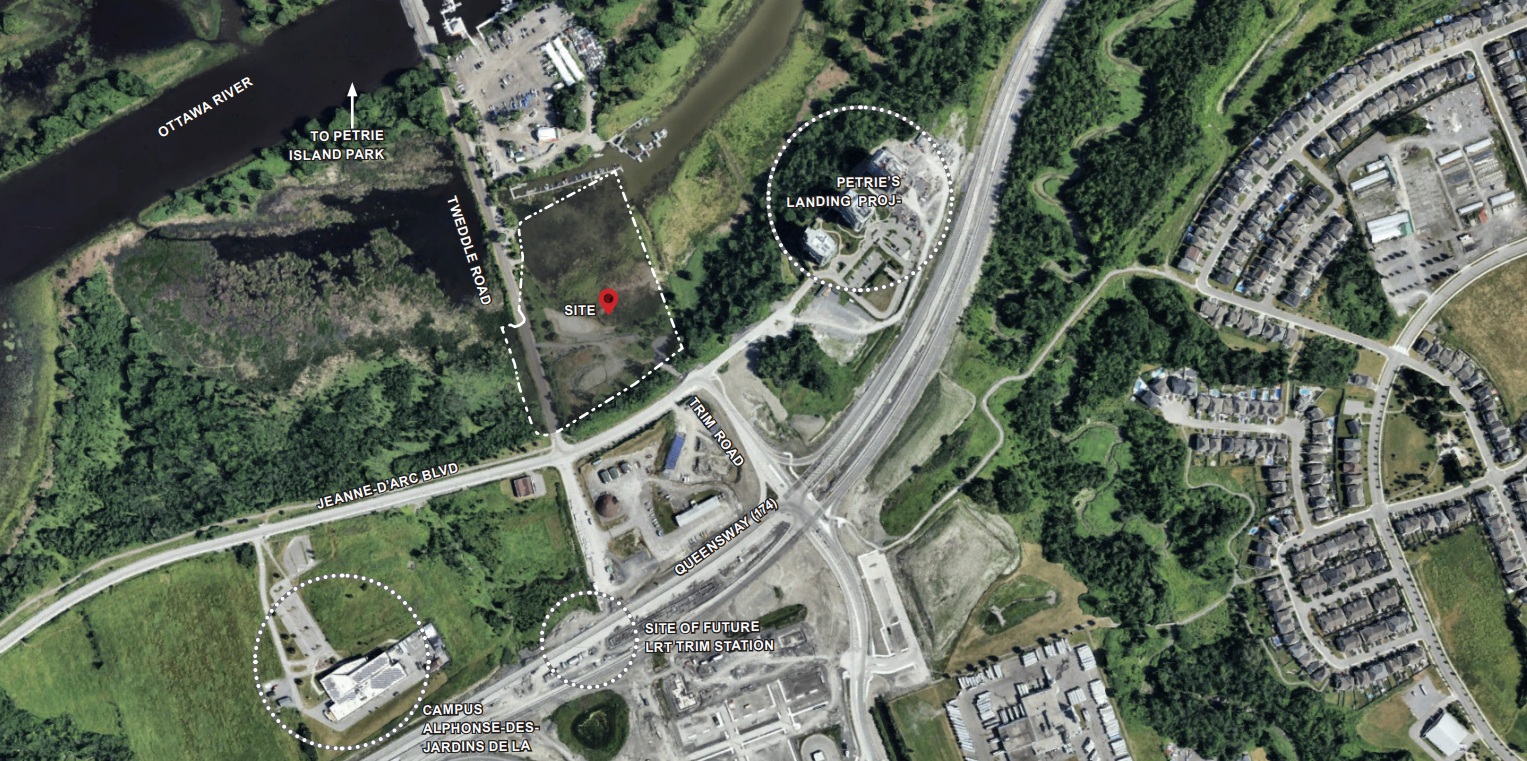
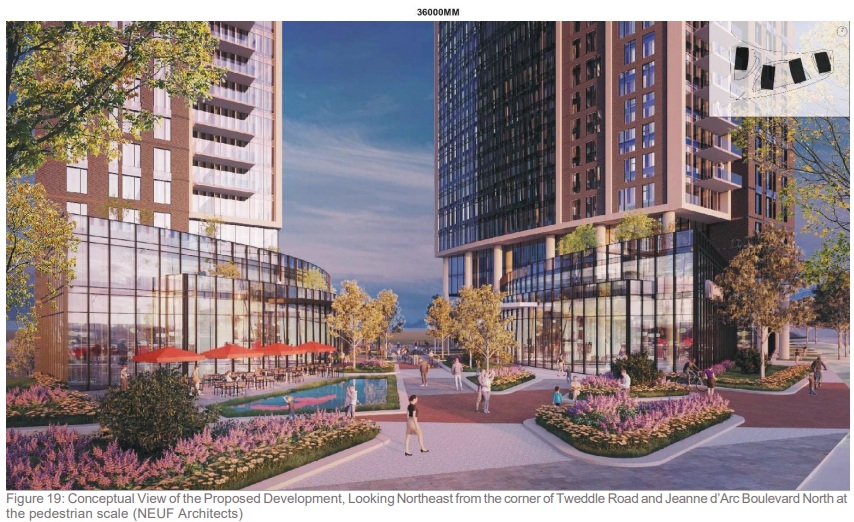
Understand: These are NOT the 4 towers off Petrie Island that are already there. These are four MORE towers being proposed right beside them.
Major difference? A rooftop restaurant on the 29th floor with panoramic views of the Ottawa River and the Sunset.
LFG.
Now I know what you’re thinking….
ENOUGH with the infill! There’s a ton of it in Orleans it’s already out of hand.
I get it.
Problem is it’s barely even begun, and there’s not much to be done about it.
If you’ve seen some of my Blog posts in the past, you’ve see how I’ve reviewed the towers coming in at 10th and St.Joes, and at the old YMCA site, and you’ve absolutely seen what I’ve said about the zoning changes bringing WAY MORE density to Orleans ( and the whole City for that matter).
The good news is that the towers are all being built in the same spot (ish) down the hill and to the far east side, and that’s exactly where they should go because all the major transportation is there. The highway, the LRT, and the major transit station there.
The other good news is the plans for a new restaurant on the 29th floor rooftop with panoramic views of the Ottawa River and the Sunset! Can you imagine how nice that will be?
A few texts. A showing. A friendly agent who seemed helpful.
The buyer wasn’t “working with anyone” officially. No paperwork. No contracts.
Just conversations.
And then everything went wrong.
The Deal That Fell Apart
In a real court case in British Columbia, a buyer purchased a large property with plans to develop it. They had a vision, a budget, and a clear goal.
After closing, they discovered something devastating.
Part of the land was suddenly restricted under agricultural zoning rules. Their development plans? Dead. Overnight.
Permits they planned to apply for? Impossible. The project they invested in? Unusable.
By the time they worked through the mess, the buyer had lost over $1.5 million.
Why Didn’t Anyone Warn Them?
Here’s where it gets uncomfortable.
The real estate agent knew about the zoning issue before closing.
But the buyer thought: “They’re not technically my agent… so they don’t owe me anything.”
That assumption was wrong.
The Invisible Relationship
Even though nothing was signed, the agent had been:
• Answering detailed questions • Helping with research • Offering guidance • Assisting with paperwork
From the buyer’s perspective, it felt like representation.
And the court agreed.
The judge ruled that the agent’s actions made it reasonable for the buyer to believe they were being represented — even without a contract.
That’s called implied representation.
It’s a relationship that forms silently… without anyone meaning to create it.
Who Was Held Responsible?
The buyer sued.
Not the seller. The agent and their brokerage.
And they won.
The court found the agent failed to disclose critical information and held them liable. At trial, damages exceeded $1.5 million (later adjusted on appeal, but still significant).
Real money. Real consequences.
Why This Matters to You
Because most people assume:
“If I don’t sign anything, I’m protected.”
Not always.
Your relationship with an agent isn’t just about paperwork. It’s about expectations and behavior.
If someone acts like your advisor… you may treat them like one.
And that’s where confusion — and lawsuits — are born.
The Lesson for Buyers & Sellers
Always be clear about:
✔ Who represents you ✔ What they are responsible for ✔ What they are not responsible for
Same number of units. Similar rents. Comparable price.
But in the real world?
One becomes a clean, predictable investment. The other turns into a slow bleed of repairs, tenant issues, and capital calls.
And the reason usually has nothing to do with the rent roll.
👉 It’s the building itself.
This isn’t just opinion — it’s where the broader market is heading.
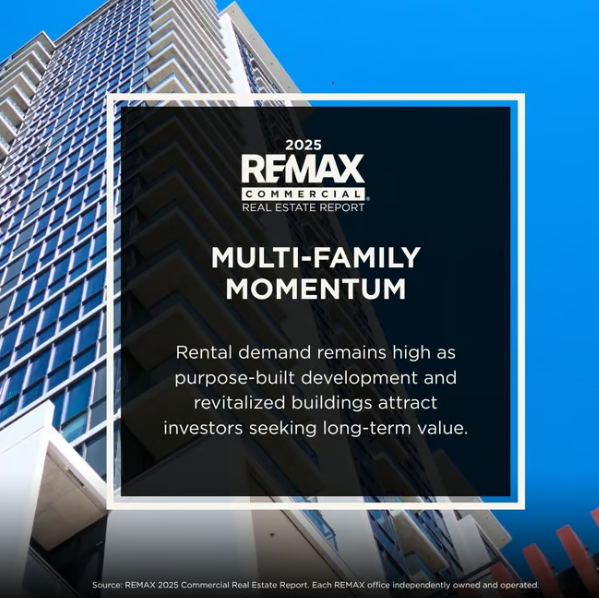
In its 2025 commercial real estate outlook, RE/MAX Canada pointed to growing economic uncertainty and global trade pressures driving a clear shift in investor behaviour — specifically a “flight to quality” and a renewed focus on fundamentals, purpose, and practicality when selecting assets.
In plain terms: Investors are becoming more discerning — and buildings that look identical on paper are no longer being treated as equal.
That’s where construction type and building origin start to matter. A lot.
Purpose-Built vs. Converted: Same Units, Different Risk
A six-plex is a six-plex… until it isn’t.
Purpose-built multi-residential properties were designed from day one to function as rental housing. Plumbing, electrical, sound separation, layouts — all intentional.
They tend to be:
More predictable
Easier to finance and insure
Lower risk for surprise renovation costs
More efficient to manage long-term
The downside? They’re harder to find — and when they hit the market, competition is usually fierce.
Converted properties, on the other hand, started life as something else — a house, office, school, or commercial building — then adapted into residential units.
They can be fantastic investments… or absolute headaches.
Conversions often come with:
Irregular unit layouts
Mixed or patched-together mechanical systems
Higher renovation uncertainty
Greater compliance and inspection risk
Converted buildings aren’t bad deals — but they demand much sharper due diligence.
The Quiet Deal-Breaker: Construction Type
This is where many investors — and frankly, many agents — stop paying attention.
Construction type affects:
Noise complaints
Heating efficiency
Insurance costs
Maintenance frequency
Long-term capital replacement
Wood-frame buildings
Cheaper to build and renovate
Better insulation in cold climates
Noisier
More prone to movement, leaks, and shrinkage over time
Steel-frame buildings
Strong and stable
Resistant to mould
Higher upfront cost
Still reliant on other systems that can fail
Reinforced concrete buildings
Fire resistant
Flexible layouts
Common in mid- and high-rise construction
Susceptible to cracking due to shrinkage and temperature change
Load-bearing masonry (common in older buildings)
Historically durable
Poor insulation
Limited flexibility for modern upgrades
Often require major mechanical overhauls over time
None of these are “bad.”
But they all come with very different long-term realities — and very different risk profiles.
Why This Matters More Than Ever
Most investors don’t lose money because they misread a listing.
They lose money because:
Maintenance costs were underestimated
Renovations were more complex than expected
Tenant experience was overlooked
The building didn’t match their risk tolerance
Two properties can look identical on paper and perform completely differently in real life.
In a market where capital is more cautious and quality matters more than ever, that difference isn’t theoretical — it’s financial.
The Takeaway
If your analysis stops at unit count, rent, and cap rate, you’re only seeing half the picture.
Ask better questions:
Was the building purpose-built or converted?
What’s the construction type?
What does that mean for maintenance, noise, and longevity?
Does this building align with your investment strategy?
That’s the difference between owning a portfolio… and owning a project.
Open houses feel harmless. Sales centres feel welcoming.
That’s exactly why buyers let their guard down.
They don’t have an agent. Or they “kind of do.” Or they think they don’t need one yet.
They’re smart people. Successful. Capable.
They just don’t realize they’ve already stepped onto the mat.
Here’s What They Think Is Happening
They think they’re:
Gathering information
Getting a feel for the market
Keeping their options open
Avoiding pressure
Seems reasonable.
But what they don’t see is what’s happening on the other side of the table.
What’s Actually Happening
At an open house, the listing agent represents the seller. At a new build sales centre, the rep works for the builder.
That’s not a secret. But it’s also not always obvious.
And it matters.
Because the person answering questions, smiling, and walking you through the space has one legal obligation — and it’s not to you.
They’re not required to:
Advise you on price strategy
Flag risks that work against the seller or builder
Help you negotiate terms that protect you
Point out clauses that quietly shift risk onto your shoulders
They’re doing their job.
You just might not realize what your job has become.
This Is Where Most Buyers Get Caught
The traps aren’t dramatic.
They’re subtle.
A clause that limits your ability to walk away. A timeline that works for the builder, not you. An upgrade list that feels optional — until it isn’t. A disclosure that technically exists, but isn’t explained.
Nothing feels wrong.
Until later.
That’s when buyers say things like:
“I didn’t realize that was standard.” “No one told me that.” “I thought I was protected.”
That’s the moment they learn the difference between guidance and representation.
I’ve Seen This Enough Times to Know the Pattern
The buyers who wander alone aren’t reckless.
They’re just unaware.
They assume someone would stop them if they were about to make a mistake.
They don’t realize that no one is obligated to.
And by the time the contract is signed, the leverage is gone.
What Having Representation Actually Changes
When a buyer is represented, the dynamic flips.
Someone is:
Legally required to act in your best interest
Required to disclose what matters — even if it kills the deal
Focused on protecting you after closing, not just getting you there
Watching for the traps you don’t even know exist
That’s not hype.
That’s obligation.
The Point
Buying a home isn’t dangerous because buyers are careless.
It’s dangerous because the process is asymmetric.
One side does this every day. The other side does it a few times in a lifetime.
Walking into that alone doesn’t make you independent.
It makes you exposed.
Final Thought
I’m not saying buyers shouldn’t look around. Or ask questions. Or explore options.
I’m saying this:
If you’re walking open houses and sales centres without someone whose job is to protect you, you’re already in the fight — whether you realize it or not.
More exposure. More competition. A better outcome.
But in a recent, real Ontario disciplinary case, that process broke down — not because of the market, but because of how it was handled.
An agent altered the offer timeline without proper written direction and failed to notify all interested parties equally. Some buyers were informed. Others weren’t. One offer was effectively given an advantage.
Real Estate Council of Ontario stepped in.
The result? A $14,000 fine, mandatory education, and a permanent public disciplinary record.
Not over price. Not over strategy.
Over process.
Why This Matters More Than People Realize
From the outside, this might sound like a technicality.
It isn’t.
Offer processes are governed by rules for a reason: to ensure fairness, transparency, and informed decision-making for everyone involved.
When those rules aren’t followed:
Sellers lose confidence in the outcome
Buyers lose trust in the system
The integrity of the transaction collapses
And the people caught in the middle are the clients — not the regulator, not the agent.
The Commentary Most People Miss
What makes this case important isn’t the fine.
It’s the reminder that intent doesn’t override obligation.
Most situations like this don’t come from bad actors. They come from assumptions, outdated habits, or a lack of awareness around how tightly regulated these processes actually are.
That’s why staying current on legislation and enforcement matters.
Not to quote rules — but to apply them properly when it counts.
How This Should Have Been Handled
Clear, written seller instructions. Consistent communication to all interested parties. Documented changes. No shortcuts.
When the process is sound, the result holds — regardless of who “wins.”
That’s not being cautious. That’s being professional.
The Takeaway
Markets move. Rates change. Timing shifts.
But the biggest risk in real estate often shows up quietly — in how things are handled behind the scenes.
In a regulated profession, trust isn’t assumed. It’s earned through competence, clarity, and adherence to the rules designed to protect you.
Because in real estate, the biggest risk isn’t the market.
Let’s get one thing straight: dropping the price is the easiest lever to pull when your home isn’t selling—but it shouldn’t be the first one.
Before even thinking about adjusting the price, you need to look at three critical things:
1. Marketing Accuracy
Is the listing doing your home justice? Are the photos high-quality? Is the description highlighting the right features? Does it tell a story that resonates with your target buyer? If your marketing doesn’t make people stop scrolling, a price drop won’t fix that.
2. Immediate Competition
Who else is out there? Take a hard look at what’s available in your price range and neighborhood. Are those homes selling and yours isn’t? If everything is sitting, it might just be a matter of time. But if other listings are moving and yours is stale, then something else is off—and it might be your price, presentation, or both.
3. Buyer Feedback
This is your direct line to the truth. Are buyers saying the home feels overpriced? Are they pointing out things that need work? Sometimes the fix is as simple as repairing, cleaning, staging, or upgrading something that’s holding people back. You want to make sure you’ve done everything else before turning to a price change.
—
So… When Is It Time to Reduce the Price?
When you’ve done all of the above—tightened up marketing, reviewed the competition, and responded to feedback—but showings are still low or offers are nonexistent, then it’s time.
But here’s the key: don’t just drop it to match the competition. Beat them.
A strategic price adjustment doesn’t just make your home more appealing—it can actually give you negotiating power back. Why? Because a well-positioned reduction sparks a fresh wave of showings, renewed interest, and urgency. Buyers may act fast, thinking they have a narrow window before someone else jumps in. That’s leverage.
—
Final Word
Price reductions aren’t about playing fair. They’re about winning the attention of the market. When the time comes, don’t just lower the price—reframe the value.
With the Canadian federal election just around the corner, a lot of people are feeling a little hesitant — and it’s showing up in the real estate market.
Right now, buyers and sellers are both hitting the brakes. It’s not because there’s anything majorly wrong with the economy today — it’s because nobody knows exactly what’s coming next. Uncertainty always makes people cautious, and when you’re talking about the biggest purchase (or sale) most people will ever make, that caution is amplified.
Across the country, home sales are down. In Ottawa, for example, sales in March 2025 were down about 6% compared to last year. Nationally, the drop was closer to 9%. That’s a pretty clear signal that people are waiting to see what happens before making big moves.
And it’s not just real estate. Elections have a way of shaking up all kinds of markets — including stocks. Right now, investors are sitting on the sidelines too. The Canadian dollar has been softer, and you’re seeing more volatility across the board as people wait to find out whether we’ll get a government that leans toward business-friendly policies or one that pushes a different agenda.
Both major parties are promising economic growth, but in different ways. The Liberals under Mark Carney are talking about boosting internal trade and infrastructure, while the Conservatives under Pierre Poilievre are focused on cutting taxes and reducing the deficit. Either way, the markets — and everyday people — want clarity before they commit.
The good news? Markets, including real estate, tend to bounce back once the dust settles. No matter which way the election goes, we’ll have more certainty, and that usually means more confidence to buy, sell, invest, and plan for the future.
Until then, if you’re wondering how this all might affect your plans — whether you’re thinking about buying, selling, or investing — feel free to reach out. I’m always happy to chat.
As a real estate investor, I’ve always believed that the best deals aren’t found online or through flashy listings—they’re uncovered by having a deep understanding of the market and consistently being on the ground. This philosophy recently led me to two incredible investment opportunities that I discovered simply by driving through areas I had been watching for years.
Investment #1: The 32-Acre Lot with Unmatched Logistics Potential
One of the properties that caught my attention is a 32-acre lot strategically located right off a major highway. What makes this parcel particularly enticing is its proximity—just one interchange away—from a major port of entry, a railway loading station, and the U.S. border. This trifecta of logistical advantages immediately signaled an opportunity for industrial development, warehousing, or a transportation hub.
I had been monitoring this area for years, watching how infrastructure improvements and cross-border trade expansion were influencing land values. When I noticed subtle changes in traffic patterns and increased industrial activity nearby, I knew this was a prime moment to act. Now, with all the tariff discussions and the federal government emphasizing the need to incentivize domestic manufacturing and production, this lot is more poised than ever to be a goldmine. As companies look to reduce dependency on foreign supply chains and establish domestic production hubs, properties like this will be in high demand.
Investment #2: The Land Assembly in a High-Exposure Town Center
The second property is a unique land assembly in a small town that is primed for growth. This site is positioned at the town’s most significant intersection, where four major streets converge. With its direct access to a major highway, it boasts unparalleled visibility and accessibility—two critical factors for commercial success.
I’ve been watching this town evolve for years, noting the steady increase in both residential and commercial activity. While many investors overlook smaller towns, I saw the potential early on, particularly as businesses began moving in to cater to the growing population. When the opportunity to assemble multiple lots at this key intersection presented itself, I immediately recognized its potential for mixed-use development, retail, or even a boutique hospitality project.
The Power of Long-Term Market Watching
Both of these opportunities reinforce the importance of patience, market knowledge, and firsthand observation. By consistently driving through these areas, keeping an eye on infrastructure projects, and understanding local economic drivers, I was able to spot undervalued assets before they became obvious to the broader market.
For investors looking to find similar opportunities, my advice is simple: spend time in the markets you’re interested in. Watch traffic patterns, note changes in zoning, and pay attention to where businesses are expanding. The best deals aren’t always on the MLS—they’re waiting to be discovered by those who know where to look.
If you’d like to know where these investments are, and would like to be kept in the know for others – send me a message 🙂
f you’re planning to sell your home this spring, you may have heard discussions about changes to the capital gains tax. Some homeowners are concerned that these changes will impact them, but let’s clear up any confusion: if you’re selling your primary residence, you are not affected.
Understanding the Capital Gains Tax Changes
Recently, the government proposed an increase in the taxable portion of capital gains from 50% to 66.7% for individuals earning over $250,000 in capital gains. Initially, this change was set to take effect in June 2024, but due to delays in Parliament, it has been postponed to January 2026.
While this change impacts some property sales, it does not apply to homeowners selling their primary residence.
Why Your Principal Residence Is Exempt
Canada’s tax laws provide a principal residence exemption, which means that when you sell the home you’ve lived in as your main residence, you do not pay capital gains tax on any profit. This exemption remains in place, and the proposed tax changes do not alter this rule.
Who Is Affected by the Changes?
While primary homeowners are not impacted, these tax changes could affect:
Owners selling rental properties
Individuals selling second homes, such as cottages or vacation properties
Real estate investors and house flippers
If your sale does not fall into one of these categories, you do not need to worry about capital gains tax on your home sale.
What Home Sellers Should Focus on Instead
Rather than being concerned about a tax that does not apply, homeowners should focus on maximizing their sale by:
✅ Timing the market well – Understanding seasonal trends and demand can help you sell at the right time. ✅ Preparing your home for sale – Small improvements and staging can make a big difference in attracting buyers. ✅ Working with a real estate professional – A knowledgeable agent can help you navigate pricing, negotiations, and marketing strategies to get the best outcome.
The Bottom Line
If you’re selling your primary residence, capital gains tax is not something you need to worry about. The rules regarding your exemption remain unchanged. Instead, focus on positioning your home for a successful sale and making the most of this spring’s market opportunities.
If you have any questions about selling your home or navigating the current market, feel free to reach out!
There’s really no difference between them, so just go with the cheapest one—right?
Not so fast.
Here are four key differences between real estate agents that can either make or break your bank account—in no particular order.
1. Their Reputation in the Industry
Does everyone hate your agent? Do they have a reputation for being difficult, unprofessional, or just plain unpleasant to work with?
This matters—a lot.
When agents negotiate deals, relationships play a role. If your agent is known and respected in the community, it can lead to smoother transactions, better negotiations, and ultimately, a more favorable outcome for you. Sometimes, real estate isn’t just about what you know—it’s who you know.
2. Their Communication Skills
Do they never get back to you?
Look, I get it—no one should be glued to their phone 24/7. But in today’s world, with smartphones in every pocket, there’s zero excuse for an agent who regularly fails to respond.
How long do you think a buyer is going to wait for your agent to call them back? Probably 0.01 seconds.
A great agent picks up when they can and calls back ASAP when they can’t.
3. Real Experience (Not Just Years on a License)
I’m not talking about the agent who says, “I’ve been licensed for 30 years, therefore I’m better.”
That’s just an appeal to job tenure, not actual skill.
You can hold a license for decades and still be terrible.
When I say experience, I mean experience selling a LOT of homes. That kind of experience means:
They’ve seen deals go sideways and know how to protect you.
They’ve handled tough situations and kept clients out of trouble.
They’ve worked through hundreds of thousands (or millions) of dollars in transactions and know how to get deals done right.
If an agent has been around for years and sells a high volume of homes, chances are they’re actually good at what they do.
4. How Much They Care
Real estate isn’t just about buying and selling houses—it’s about changing lives.
This job comes with serious responsibilities, and the right agent doesn’t just handle transactions—they genuinely care about their clients.
Beyond being professional, responsive, and experienced, your Realtor should give a damn about you, your family, and your future. They should care enough to do their absolute best—because these decisions have real, lasting consequences.
Is That Too Much to Ask?
I don’t think so.
When choosing an agent, look beyond the price tag. The right agent can be the difference between a smooth, successful transaction… or a financial nightmare.





 The Evans Real Estate Group Blog