
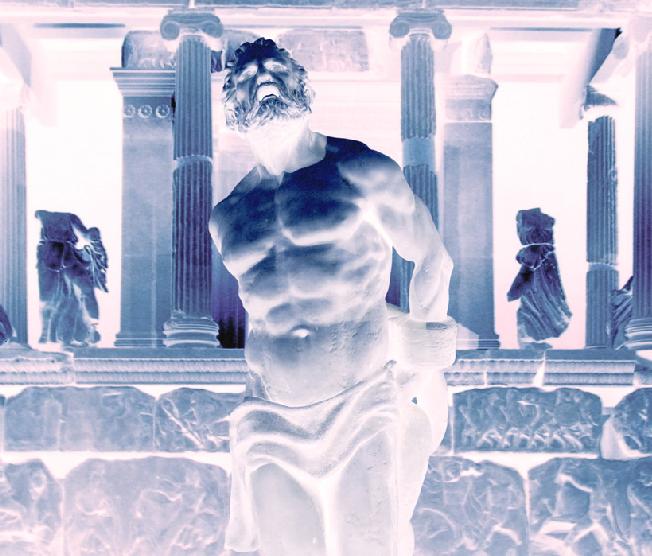
Greek mythology is a wonderful collection of traditional stories that have a tremendous importance to Greek society. One of these types of myth is divine myth, whose main characters are divine beings involved in a plot which often parallels theoretical science in that it attempts to explain aspects of the natural and social environment. Interestingly enough, these myths are often transmitted orally, which inevitably leads to a great deal of evolution of the myth itself, and therefore allowing for differing perspectives of the same tales. An excellent example of a divine myth which has changed both shape and significance over time is that of Prometheus as illustrated by first Hesiod in Theogony, and then Aeschylus in Prometheus Bound. In these plays that were created over three centuries apart, the character Prometheus evolved from a typical trickster who is to blame for humanity’s hardships, to a celebrated divinity responsible for bestowing great benefits upon mankind.
In Theogony, Hesiod describes a meeting between Prometheus and Zeus where Prometheus attempts to play a trick on Zeus. He presented Zeus with two gifts; one of ox meat inside the ox stomach ( edible food encased in undesirable wrapping) and the second being ox bones enveloped in ox fat (non-edible parts packaged in savoury and delicious wrapping). “Zeus, most glorious and greatest of the eternal gods, take which ever of these portions your heart within you bids” Prometheus exclaimed.
“But Zeus, whose wisdom is everlasting, saw and failed not to perceive the trick, and in his heart he thought mischief against mortal men which also was to be fulfilled. With both hands he took up the white fat and was angry at heart, and wrath came to his spirit when he saw the white ox-bones craftily tricked out”(Theogony, 548-558).
What Zeus proceeded to do next was punish mankind by taking fire from them. Prometheus, not to be outdone, pleaded with Athena for re-entry to Olympus, where he proceeded to steal the celestial fire and smuggle it in a giant fennel-stalk and bring it back to earth for mankind. This is where Hesiod’s version of Prometheus and his actions start to take an identity of its own. Hesiod describes Zeus as a wise and noble god, who is a victim of Prometheus’s trickery and theft. An example is: “So spake Zeus in anger, whose wisdom is everlasting…” (561), and “But the noble son of Iapetus outwitted him and stole …” (565) and also as seen in Hesiod’s Works and Days , “Prometheus the crafty deceived him”(42-53). The price Zeus made mankind pay for these actions was to have Hephaestus and Athena create Pandora, and “contrived within her lies and crafty words and a deceitful nature” (69-82). He gave her a jar full of ills, hard toil and heavy sickness that would soon be unleashed upon man. Zeus sent Pandora down to Epimetheus, who of course accepted her and quickly enough Pandora opened the jar and scattered all the ailments upon mankind. Hesiod not only depicts Prometheus in a negative light, and Zeus in a positive one, but he clearly attributes Prometheus’s actions as the cause of all of mans hardships and illness through Pandora’s arrival as punishment for his behaviour.
Aeschylus chose to take a much different perspective of Prometheus in his play entitled Prometheus Bound. Before the theft of fire had even occurred, it is understood that not only was Prometheus instrumental in Zeus’s victory in the Titanomachy, he is also responsible for saving the human race from destruction at the hands of Zeus. In regards to the Titanomachy, Prometheus explains how his effort was not recognized: “Which things by me set forth at large, they scorned, Nor graced my motion with the least regard”. Furthermore, in regards to saving mankind:
“Rather it was his wish to wipe out man and rear another race: And these designs none contravened but me. I risked the bord attempt, and saved mankind from stark destruction and the road to hell.”
Prometheus then explains how he is the victim of Zeus’s wrath,
“But, for compassion shown to man, such fate I no wise earned; rather in wrath’s despite am I to be reformed, and made a show of infamy to Zeus.”
In this play, the perspective has shifted to that of betrayal on the part of Zeus, who is now depicted as vengeful, and irrational. Another main difference between the two pieces is that in Prometheus Bound, there is no mention whatsoever of Pandora, or of the sacrifice of ox parts that was so famous for Prometheus’s labelling as a trickster. These are very significant events that have been omitted, and completely change the perspective of protagonist and antagonist throughout the myth. Finally, Prometheus Bound illustrates that Prometheus is privy to some very critical information that was provided to him from his mother (who is now said to be none other than Gaea). Here Prometheus is made aware of the name of the woman that would be Zeus’s future wife and give birth to a child that would eventually overthrow him. This difference gives a significant complement to Prometheus’s involvement in Zeus’ early victory, in that now he is has control over his potential downfall as well.
It is indeed a very interesting characteristic of myth to be able to take such a different perspective over time, as it so clearly does in this case. In Hesiod’s Theogony, the tale of Prometheus is one where he is a sneaky trickster, a thief, and clearly the cause of all of the evils cursed upon mankind. He is depicted as the antagonist not only to Zeus but also to the entire human race. Some three hundred years later in Aeschylus’s Prometheus Bound, this relationship is reversed. Here, Prometheus is depicted as a hero in a sense that he sacrificed his freedom for the benefit of mankind, and he is betrayed by a cruel tyrant in Zeus, despite being one of the people that helped him arrive and stay in power. Staying true to the nature of divine myth, both accounts are parallels of the time’s theoretical science as played out by divine beings; however in this case, the dynamic of the myth has evolved over time and has exposed two differing and yet complementary perspectives. The study of Greek Myth is beyond doubt an adventure in itself!

 The Evans Real Estate Group Blog