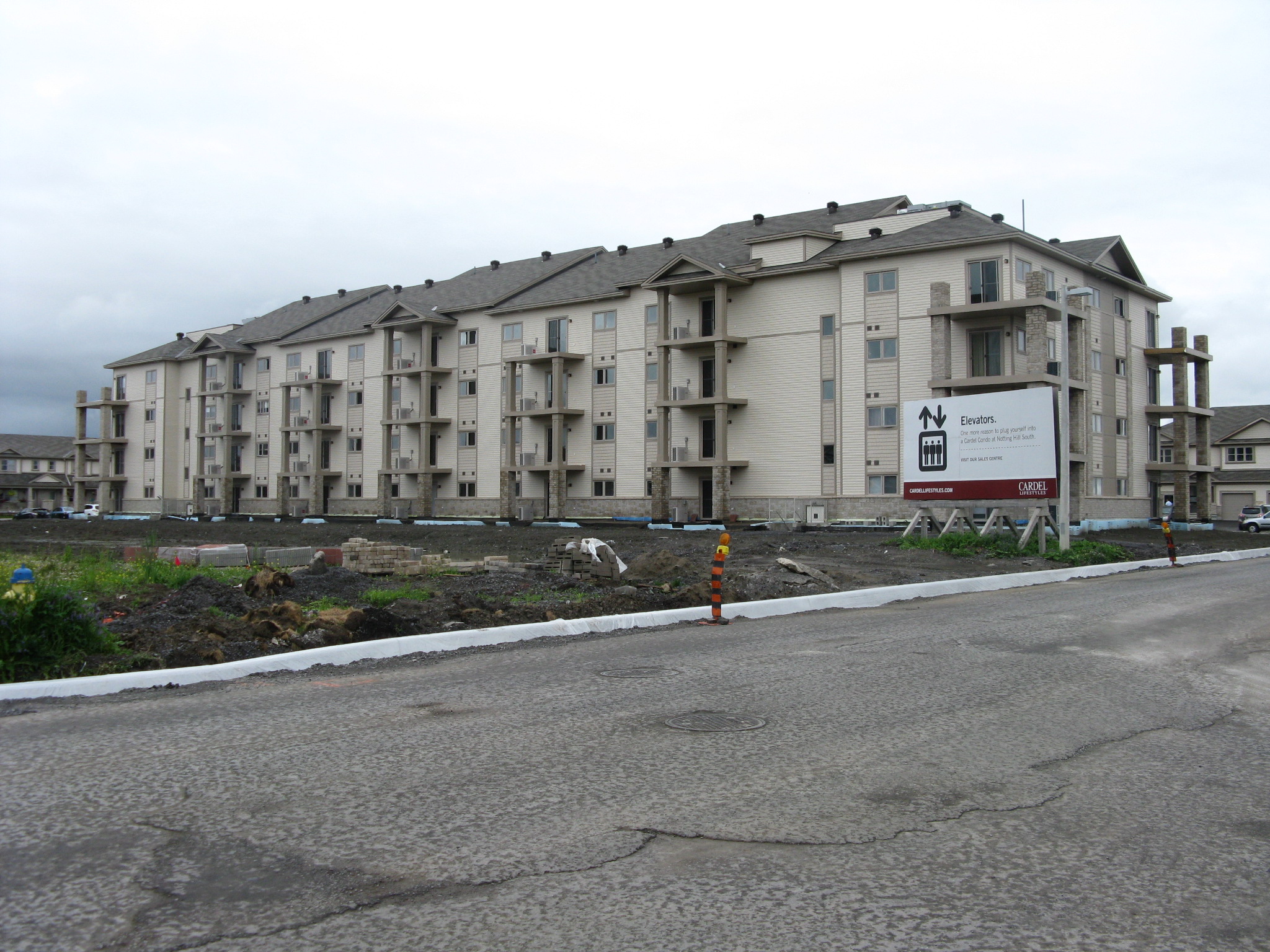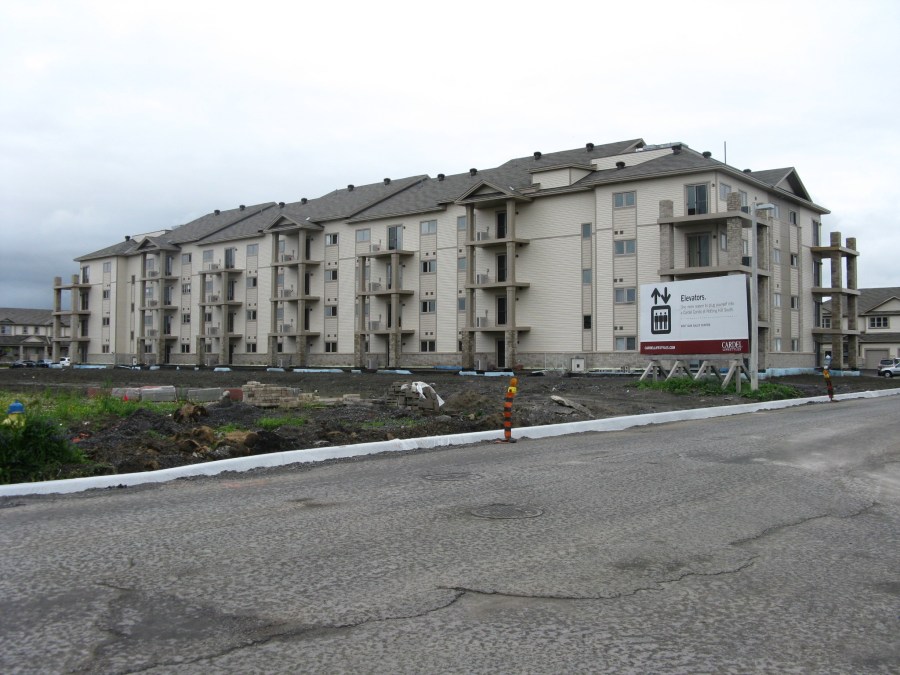
Cardel Apartment Building in Notting Hill

Have you seen the behemoth of an apartment building that Cardel is building in Orleans’ newest and ever-growing neighbourhood of Notting Hill? They are nearly complete the 1st phase of the apartments, and the release of the showrooms is just around the corner!

The building has slightly over 40 units, range from 625 s.f. to just under 1,000 s.f., include six appliances, underground heated parking, elevators and storage – not to mention Cardel’s trademark rich and luxurious styles and finishes throughout. The condos start at just under $200,000, and the largest units on the top floor can be purchased for just under $300,000.

Now I’ve had the opportunity to step inside the building before the showrooms were launched, and I took some great pictures that I will share with you! I’ve got to say – their layouts are incredibly functional. They have wide open floor plans, master bedrooms with large walk in closets and ensuite washrooms, 2nd bedrooms on the other side of the apartment for privacy, beautiful kitchens conventiently tucked away in the corners with oversized islands for entertaining, formal entrances and the two larger models even have a defined dining space.

I must admit, having an apartment building in the centre of townhomes, which are themselves surrounded by singles, does seem a bit odd; not to mention the sheer size of the building makes it stand out. After some good consideration however, the building is really a blessing to Orleans and to Notting Hill alike. Let me explain.

There are a few apartment buildings in Orleans – the Brigil complexes at Briargate (Trim and Innes), and some very old buildings down on Jeanne D’Arc near St.Matt’s (note: Terrace homes, while mistaken for apartment buildings, are not. These are what we see in Avalon and Convent Glen). Every apartment building so far has seem to pose certain challenges that become the next developer’s strong suit. For example – the building near St.Matts is a quite practical concept, however it is buried right smack dab in the middle of the suburb. Having so much density at the heart of a suburb somewhat congests everything. Enter Briargate – Brigils endeavor to introduce an apartment complex to Orleans, this time being situated right off Trim Rd (transportation and congestion solved!). This development caught on quite fast, however some people have remarked that it is still not quite perfect – the lack of elevators being the main disadvantage, with others commenting on the commercial neighbours and high traffic making the complex seem a little more like a piece of downtown than they had bargained for. Finally, parking outside, and having to bring groceries up trip after trip, in Canadian weather mind you, can be tiresome.

Now let’s look at the Cardel apartments. Larger building, newer building, rich finishes – so the quality is clearly there. But look at the location – still off of Trim Rd (Pinnacle then Fieldfair to be exact, but about 20m from Trim Rd.), and is gently set back into the suburb and separated from the main road by a single row of towns. This allows for the building to have as little impact on traffic congestion as possible, gives the residents of the building fantastic access to the highway, and all the while helps them feel less ‘industrialized’ if you will. They get their own piece of the suburb, without infringing on the lifestyles of those around them that want to enjoy a little elbow room. As for the elevators – leave it up to Cardel to install them from the top floor, all the way down to the underground heated parking and to have storage lockers directly in front of the parking spots as well.

Having this building in the mix with townhomes and singles allows for a great diversity of lifestyles, allowing the young couples to mix with their single friends, empty nesters, and relatives with large and growing families. Throw in some MASSIVE road improvements (Trim expansion, Brian Coburn rd aka Blackburn Bypass, roundabouts and OC Transpo plans at Millenium park n ride), you have a recipe for a functional and vibrant community that will be taking care of families for decades. Did I mention that Bradley’s and Lavergne’s Western Beef are just around the corner?

If you would like to view the Cardel apartments, give me a call at (613)868-4383, or email me at marcevans@remax.net, and let’s get out to see them!

Post Script: I forgot to mention – they are building an identical building beside the existing one, and prices WILL go up!

March Sales back to normal after HST fueled 2010

Members of the Ottawa Real Estate Board sold 1,232 residential properties in March through the Board’s Multiple Listing Service® system compared with 1,495 in March 2010, a decrease of 17.6 per cent. The five-year average for home sales in March is 1,256.

Of those sales, 296 were in the condominium property class, while 936 were in the residential property class. The condominium property class includes any property, regardless of style (i.e. detached, semi-detached, apartment, stacked etc.) which is registered as a condominium, as well as properties which are co-operatives, life leases and timeshares. The residential property class includes all other residential properties.

“As you can see, last month we experienced a typical average March in terms of resale home sales. That certainly was not so last year for the same period. The effects of the introduction of the Harmonized Sales Tax in July were already being felt last March as more buyers leapt into the market to try to avoid taxes on the services associated with a real estate transaction,” said Board President Joanne Tibbles.

“Years in which there are unusual market forces, such as the HST in 2010, tend to create skewed comparisons with subsequent years. Despite the lower volume of units sold, the average price continues to rise slightly, indicating that we are still in a healthy balanced market. Ottawa’s housing market is actively moving along as it typically does in early spring,” Tibbles added.

The average sale price of residential properties, including condominiums, sold in March in the Ottawa area was $346,148, an increase of 4.9 per cent over March 2010. The average sale price for a condominium-class property was $253,763, an increase of 6.5 per cent over March 2010. The average sale price of a residential-class property was $375,364, an increase of 5.6 per cent over March 2010. The Board cautions that average sale price information can be useful in establishing trends over time but should not be used as an indicator that specific properties have increased or decreased in value. The average sale price is calculated based on the total dollar volume of all properties sold.

Resale homes sold more quickly in February

Members of the Ottawa Real Estate Board sold 936 residential properties in February through the Board’s Multiple Listing Service® system compared with 1,030 in February 2010, a decrease of 9.1 per cent.

Of those sales, 213 were in the condominium property class, while 723 were in the residential property class. The condominium property class includes any property, regardless of style (i.e. detached, semi-detached, apartment, stacked etc.) which is registered as a condominium, as well as properties which are co-operatives, life leases and timeshares. The residential property class includes all other residential properties.

“Once again we’re seeing sales numbers very close to the five-year average for February, which is 962 sales. It’s important to note that the homes that sold last month did so far more quickly than in January, spending an average of just 33 days on the market. As well, prices rose slightly more than they had in the previous two months which indicate we still have a very steady market here in Ottawa,” said Board President Joanne Tibbles. “This tells us that there is a demand for resale homes in Ottawa, and that when buyers see the home they want, they’re going after it, perhaps even going up against other bidders,” Tibbles added.

The average sale price of residential properties, including condominiums, sold in February in the Ottawa area was $338,408, an increase of 6.7 per cent over February 2010. The average sale price for a condominium-class property was $260,112, an increase of 6 per cent over February 2010. The average sale price of a residential-class property was $361,475, an increase of 6.9 per cent over February 2010. The Board cautions that average sale price information can be useful in establishing trends over time but should not be used as an indicator that specific properties have increased or decreased in value. The average sale price is calculated based on the total dollar volume of all properties sold.

The Ottawa Real Estate Board is an industry association of 2,600 sales representatives and brokers in the Ottawa area. Members of the Board are also members of the Canadian Real Estate Association.

The MLS® system is a member based service, paid for by the REALTOR® members of the Ottawa Real Estate Board. The MLS® mark symbolizes the cooperation among REALTORS® to effect the purchase and sale of real estate through real estate services provided by REALTORS®. MLS® commercial and residential listings are available for viewing on the Board’s internet site at http://www.OttawaRealEstate.org and on the national websites of The Canadian Real Estate Association at http://www.REALTOR.ca and http://www.ICX.ca.

source: Ottawa Real Estate Board

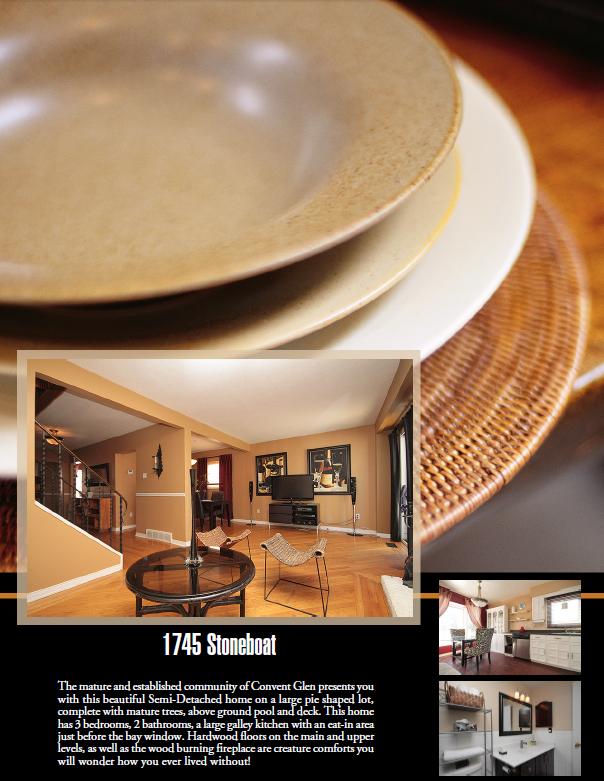
1745 Stoneboat – Here and Gone!

Here is a glimpse into the execution of a quick sale I just made:
– Figure out what the active comparable sales are
– Figure out what the sold comparable sales are
– Determine what the house should sell for, and the highest we can ask while still making the property appear to be the best value
– Determine what kind of people live in the area and pay most for it (cross reference Cencus info, postal info and sales info)
– Make some home enhancements (touchups or renos, staging suggestions, adjustments to curb appeal)
– Capture the home in it’s best light (Professional photography and marketing pieces)
– Put together an info package that appeals to the target market identified above
– Make description of area, street, and home appeal to the target market
– Same with the imagery in your marketing
– Market the home on the lifestyle the target market will have in this home – sell on emotion!
– Submit property to MLS, private website, and 35 others to hit major search engines
– Distribute info packages to realtors that just sold similar properties and that may have leftover buyers
– Clear the home for a good dozen showings on first day
– Receive the offer (easy at this point)
– Negotiate with the agents to get your full price and all the terms you need (you need to know your stuff for this)
– COOPERATE with the agent and help them sell the property to their clients
– Let all the other agents that showed the property know there is an offer, which makes them all jump and drives competition for your clients
– Negotiate until you have the strongest offer on the table that your clients are willing to take
– Accept it
– Manage the conditions and help the other realtor do so (to make it easier)
– Negotiate to not “rock the boat” throughout the conditional dilligence
– Close it!

The keys to this one were:
– Targetted Marketing which attracted those buyers that were willing to pay the MOST for the property.
– Pricing the home correctly, so that it appears to be the best value in the marketplace and will still net your clients the most possible. Any higher helps sell the competition.
– Professional marketing to showcase the quality
– Strong negotiating to get and keep as much money on the table as possible
– a great cooperating brokerage with competent agents
– burning the candle at both ends to communicate with ALL realtors to drive competition for your client

Result? Everything my clients wanted be end of the same day it was listed.

Note: These results often make our job look easy i.e.” I can put a sign up and sell for full price in one day too!”, or ” I can’t justify paying a realtor for 1 day’s work”. What they dont see is a great deal of intelligent work and strategic planning that was put into it, to pull the trigger and hit the target as quickly and as accurately as possible.

I would argue that these results are actually a TESTAMENT to the excellent work performed by some agents.
What more could you ask for?

In the end, I’m happy that my long hours and hard work paid off, my clients are shocked it went exaclty as planned, and we are all happy.

Special thanks to the fantastic Realtor’s on the other end in this one – LOCKE Real Estate. They hustled to get this deal for their buyers, and it was well deserved. Bravo.

Marc

Feature_Sheet

Are Your Energy Bills Too High?

If you would like to reduce day-to-day energy consumption and lower your
monthly costs, try these practices:
1. Wash only full loads of dishes or clothes.
2. Use cold water for more loads of laundry; hang clothes to dry when you can.
3. Air-dry dishes with the washer door open.
4. Make a sweep through each room before going to bed (or before leaving home for a longer
period of time) and turn off all electrical devices, including television or stereo equipment,
gaming consoles, computers, monitors and printers.
5. Unplug appliances or use power strips to avoid “phantom” energy use, as most electronics draw a
small amount of power even when they are turned off.
6. Use fans for cooling rooms instead of air conditioning.
7. Close window coverings when the weather is warm to keep out heat generated by direct sunlight; open them up when it’s cool outside so the sun’s rays can help warm the space.

Why do mortgage rates rise quickly but fall like molasses?

That’s the question posed by an article in the latest issue of the Bank of Canada Review, and it’s a good one.

The report, by Jason Allen of the central bank’s financial stability department, notes that the big banks that dominate the market tend to adjust interest rates faster when they’re on the way up than they do when rates are falling.

While it come as no surprise to borrowers that such is the case, the article draws an interesting conclusion: That such behaviour by banks and other lenders may have broader implications for Canada’s monetary policy, and that the central bank may want to take this into account when it comes time to plot strategy.
The report comes on the heels of a decision by the federal government to tighten mortgage rules as a way to head off a potential real estate bubble.

All the major lenders in this country tend to offer the same types of mortgage products, credit cards and other services, and in fact Canadians tend to treat their bank as a “one stop shop” where they buy a majority of their financial services, according Mr. Allen.

Leaving aside the issue of whether this is a healthy situation, the author concludes that the mortgage market is “consistent with a model where consumers have different preferences and skills when shopping and bargaining for a mortgage and where lenders maximize profits based on observing these preferences and skills.”

Simply put, borrowers are often complacent and end up paying more than they should.

One of the quirks of the industry in Canada is the prevalence of mortgages with terms of five-years or less, even though the loans amortize over as much as 40 years, according to the article.

Citing a recent study by John Kiff, a senior financial sector expert at the International Monetary Fund, it notes that Americans, by contrast, tend to opt for longer term mortgages than do Canadians, and they have a much broader choice.

The benefit of longer terms is that they provide the borrower with better protection against the risk of rising interest rates. If a loan is amortized over 25 years, the best way for the creditor to ensure he can always make the payments is to take a 25-year term.

Some economists refer to five-year products as “balloon mortgages” because of the possibility that the payments may suddenly shoot up at the end of the term.
Borrowers are also left vulnerable to “roll-over risk,” that the lender may be unwilling to renew the loan at any price.

According to Mr. Kiff, the main reason 10- and 20-year mortgages aren’t more common in Canada is because financial service providers consider them uneconomical.
Whenever banks make home loans they generally protect themselves from the risk that the customer may pay the money back early by including strict repayment penalties. But current regulations put strict limits on such penalties. “So the banks have this wall at five years,” Mr. Kiff said in an interview.

Bottom line: Lenders can’t charge what they feel they need to charge so they don’t offer longer term mortgages at an affordable price.

Mr. Kiff, who previously worked at the Bank of Canada, said Canadians would be better served if there was more choice of longer term mortgages. The IMF recently recommended that the federal government change the rules around mortgages so that lenders are able to provide broader product choice without unnecessary limits on how they charge for products.

What needs to happen is “at least, let the market determine where the rates should be,” he said. “What [mortgage] works best depends on the borrower, on the borrower’s own personal situation.”

jgreenwood@nationalpost.com

Original Source: http://business.financialpost.com/2011/02/17/why-do-mortgage-rates-rise-fast-fall-slowly/

Balanced Market in 2011?

CREA released a revised forecast Tuesday that estimates that 2011 home sales will be down 1.6%, and that prices are estimated to rise by 1.3%. With regards to the forecasts in sales activity, “CREA predicted Tuesday that some sales that would have been made later in the year will likely occur in the first quarter, as a result of the new rules.

Some economists have warned that a combination of higher interest rates and new mortgage rules that go into effect March 18 could put a chill on demand in the later months of this year”. “This is expected to produce a milder version of the volatility in sales activity that we saw last year which resulted from additional transitory factors,” said CREA’s chief economist Gregory Klump.

So we are looking at an active trading season over the spring, but does that mean the summer and fall will be slower than normal? Normally yes, as CREA said earlier – “some sales that would have been made later in the year will occur in the first quarter”, however, CREA also goes on to say that the market will gain traction in the second half of this year as economic conditions, job and income growth and consumer confidence improve, in contrast to 2010 when economic growth softened.

So all in all, it looks like we have some stability in the forecast. The spring will be a little exciting as usual, then it will likely slow at the tail end of the spring, then come back to normal throughout the summer.

RBC gives similar values and a similar story in this report: http://www.cbc.ca/money/story/2011/02/10/rbc-housing-forecast.html

It’s not a sexy market, but the word is FAIR.

Flaherty tables new rules to curb household debt

By David Akin, Parliamentary Bureau Chief

Last Updated: January 17, 2011 8:15am

OTTAWA – The federal government Monday tabled a series of new rules aimed to curbing what it sees as the growing problem of household debt.

Finance Minister Jim Flaherty is changing the maximum length of most mortgages to 30 years from 35 years; cutting the maximum that can be borrowed against a person’s home and eliminating government-backed default insurance of home equity lines of credit.

Prime Minister Stephen Harper said Friday his government was “concerned about growth in the level of household debt.”

Bank of Canada Governor Mark Carney has also been warning of the dangers of rising debt levels.

The key tool the federal government uses to control the mortgage market is the Canada Mortgage and Housing Corp. (CMHC). Banks typically will not provide a mortgage to anyone with a down payment of less than 20% of the purchase price unless the CMHC is willing to backstop the loan.

The CMHC will now no longer insure any mortgage with a term longer than 30 years. Until the change, it was insuring 35-year mortgages.

Flaherty also instructed the CMHC it can no longer insure home equity lines of credits (HELOCs). That means individual banks will be on the hook for any HELOC defaults.

Because banks will assume all of the risks of default, banks are expected to tighten up eligibility requirements for HELOCs.

Finally, a person who wants to take out a loan against their home will be able to borrow a maximum of 85% of the value of their home, down from 90%.

Real Estate Production 2010

These values were calculated from RE Stats from the MLS information as provided by the OREB for 2010. The brands that were not in the top 4 are not included in this graph, however their sales are used to calculate the average number of units per salesperson (that is the 12.5 number) that is shown in the blank bar in the table .

It proves again the difference between us and the others, and the value that the RE/MAX brand brings to the table.

Real Estate Brokerages and Their Agents in 2010. How did they fare?

I had REMAX Ontario Atlantic review all the stats from the OREB for the whole of 2010.

Results are:

market share: Royal Lepage 31.97% (they have 32.5% of the Realtors)

market share KW 15.2 % (they have 18.2% of the Realtors)

market share REMAX 19.45% (we have 13.86% of the Realtors)

Summary: # units per Realtor in 2010

REMAX 17.62

Royal Lepage 12.37

KW 10.3

*note the average for all companies combined is 12.6 units per Realtor

Or, REMAX agents are 72% more productive than KW Realtors, and 42.44 % more productive than Royal LePage Realtors.