Townhomes in Orleans – A little analysis

I recently dug into the sales activity in my neighborhood of over 27 years – ORLEANS.

I wanted to look at the most popular housing in my age group – TOWNHOMES.

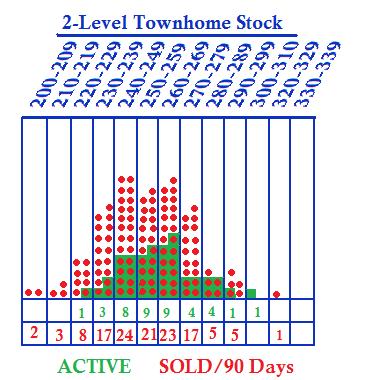
I identified what price ranges all the activity is happening in – here it is (I plotted it in an MS PAINT graph to make it easier to understand):

 towns


As you can see, most of the activity flows around 250K.

Lets say you put 5% down, or $12,500 – your mortgage amount would be $237,500.

Your MORTGAGE PAYMENTS would be around $1,070.00 with todays posted rates from one of my recommended mortgage brokers.

Are you paying more than that in RENT right now? I sure hope not!

You should know, this number does not include payments on  mortgage insurance or property taxes – which you can very well pay seperately.

One last thing – almost all of these towns sold within a 1km radius of Innes and Tenth Line!

Coincidence that this is the kind of house I’ve been helping people buy in that area?

I am where the market needs me to be!


Cheers

This is what a Fortune looks like when it is born.

Remember my rant about the best things in life being free? Free things like information?

Remember how I said some people would find it scary that I would make this information public to you, since they would rather make it seem like they came with the information themselves, or they would rather bait you with it?

Well, too bad for them…

I want you and everyone to have this information so we can elevate ourselves in terms of our savviness, real estate positioning and subsequent financial success. Let’s all have incredible properties!

Here is a start – INFORMATION. This stuff is actually PUBLIC information – but I doubt any of you know how to access it!

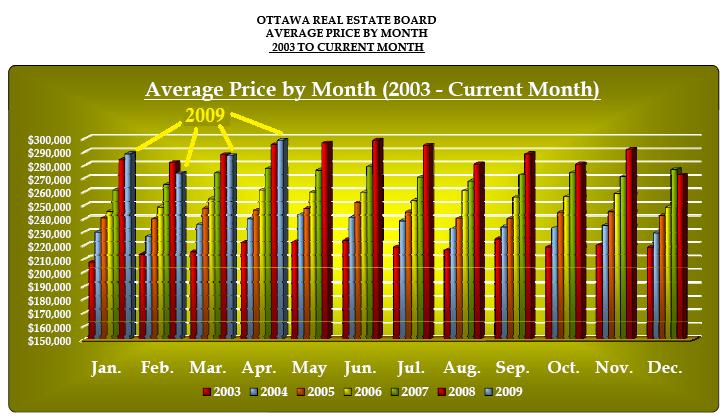
First up – Month over month information. Remember all the buzz about a recession? Lets look at Ottawa activity, month over month since 2003.

Graph2

See the 2009 months I highlighted? (the ones we have gone through already) On average, ther are not too off from 2008 averages – slightly above in some cases, slightly below in others.

See the decline in 2008 prices from about June to December (in red?) Then our latest few months have indicated an INCREASE!

Now look at a specific batch of years by month. lets look at January for arguments sake (first one). 2003 to 2009 = see the increase? A little over 200 to just under 290 in 6 years!!

These numbers are from the Ottawa Real Estate Board a.k.a the horses mouth – so dont just take my word for it!


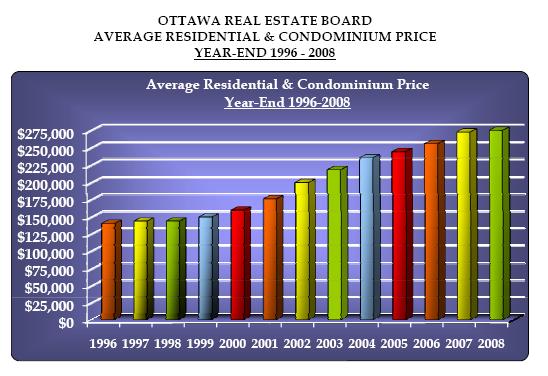
Here is another quick one: Year over year since 1996 – so 13 years and a few months

Graph

What does that say – about 137.5K to about 268-270K ?

Think about that… if you bought a house for 137.5K ten years ago, you would now have 132K in appreciated equity PLUS whatever the principal went down to over time, PLUS whatever POSITIVE CASH FLOW you would have earned over time as a result of making the most out of your equity in your house (i.e. after 5 years, taking out equity to finance a low maintenance investment property that earns you hundreds of dollars a month IN YOUR JEANS).

Ever feel like wealth is just too far out of reach to even properly imagine? Ever wonder how people have made their fortunes, and dream of having seemingly endless supply of cash to rely on?

I do! All the time! Thats why I got into this business. To build wealth over the long term and to pass that on to my family and future generations.

This is what a fortune looks like in the beginning.

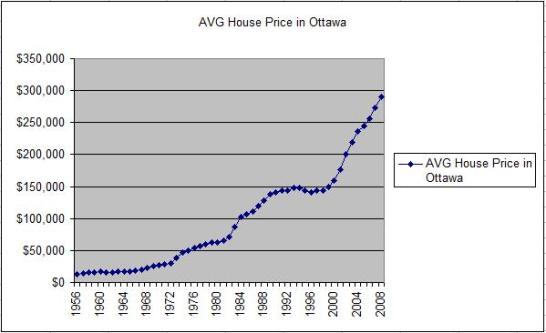
How about over a longer period of time? Here you go! (from an earlier post)

avg-sales 

Imagine what kind of Fortunes a 60 or 70 year old person could be leaving his family based on these figures!

Imagine if that person would have properly leveraged themselves in Real Estate and grown their portfolio over time!

Pick yourself up some Real Estate for some of the best rates this country has had in over 50 years!

Bank of Canada will show you the record lows we are experiencing right now – Prime at 2.25%!!!!

CPI (Consumer Price Index – average price increase of a basket of goods) is down to 1.2% while the average wage increase is up to 4.3% this year! Purchasing Power is HUGE right now!!

I’ve given you the information – what are you going to do with it?

The Best Things in Life are Free

You know what really threatens people? INFORMATION.

Information about them, information about where they live, what they do, what language they speak, and what religion they practice.

One would think that we are fortunate enough that by living in Canada, we don’t have to worry about these types of differences causing any kinds of major problems, right?

Now I’m not so ignorant to think that small prejudices don’t exist and won’t impose themselves on people in their everyday lives –but there really isn’t any reason, in my opinion, to want to hide anything.

 As you know, I work in Real Estate. I am blessed to be doing something that I love, with co-workers that are incredibly devoted, and I get to work with people in an exciting time of their lives. One thing that I like to do with my clients – is provide them with INFORMATION. I give them insight into different areas and housing types, specific information and research on certain specific houses, sales history, sales trends, and surrounding sales comparables. Quite often enough, my clients are blown away by the resources that I have at my disposal – and rightly so. I think they are pretty darn powerful myself! After all, in this day and age, privacy is a thing of the past, right? My affiliations within Organized Real Estate (Municipal, Provincial and Federal) give me access to a tremendous amount of information from the Land Registry System, Statistics Canada, Various Boards of Director’s professional opinions, and a seemingly limitless amount of related professionals to tap into (Mortgage Brokers, Lawyers, Home Inspectors, Engineers etc). All of this is INFORMATION – and I am not afraid to give it to you.

 But there are people who are.

 Some people would rather hoard information as to make it seem like they are pulling magic strings and digging up this information from a mixture of expertise, elbow grease and connections in the marketplace. As a matter of fact – my mentor and Broker at Partners Advantage GMAC , Dr.Bruce Firestone, has advocated ‘free information’ for YEARS! On his personal website – http://www.dramatispersonae.org – he writes: 

 “MIT has taken the position that it will put all of its course outlines, course materials, even examinations on the web for free. The engineers at MIT are among the smartest in the world. They feel confident that this will enhance the MIT experience- essentially; they are saying that they don\’t care if someone on another part of the planet wants to teach a MIT course or use their material. They believe that the spread of knowledge can only benefit humankind. MIT will instead, as my friend Professor Tony Bailletti says, sell the \’delta\’ factor- that is, the opportunity to actually be in a classroom with the creators of the material; to be exposed to their minds; to experience first hand the Socratic method of student/teacher interaction”

 So where am I going with this? Here is my dilemma – I want to give out INFORMATION, and I am a week or two away from doing so. I want to provide my people with relevant information about their housing types in their areas so they can make informed decisions, have accurate opinions, and make good judgments about their own property values. How would you feel if you got a monthly report card in your mailbox that outlined the location and size of sales activity in your neighborhood? I think it would be pretty cool. I think it would not only help people as I described above, but I think it would help stabilize the equilibrium in our Real Estate market – albeit a small effect as it may be. What I mean is – people would not think their property is worth 30K higher or lower that it really is, as they perhaps would have had they not had access to such information I want to provide them with. People just don’t know! And its not their fault. I want to help. If the prices on the marketplace can more accurately reflect what their true market value should be – then the marketplace will be more efficient. People will sell their houses faster, no parties would be getting ‘ripped off’, and all stakeholders would benefit from the transparency and logic of free market influence. What is so scary about that?


As I said earlier – some people would rather protect that information and make it seem like they are the experts that came up with this information on their own, and it is part of their value proposition. Well – it is part of a Realtors value proposition.

 Here is the key – its only PART of my value proposition. A very small part. I would call it a given.

 I am not afraid to make that information available and risk a FSBO (For Sale By Owner) try to sell their homes themselves. I am not afraid of people taking this information and going to another Realtor out there. I am not afraid of other Realtors copying my idea and giving you the information in my place. Why?  Because the information is NOT what makes the difference between me and others. The information is FREE – take it. I want you to be more informed!

 Regardless of who out there has information – I would bet I am in the top 1% of the hardest workers out there in the game. The difference that I bring to the table is I push the limits of effort exerted for my client’s interests. I get out on the street and I work HARD. Part of my business model is to focus on my core competencies and make my own ground rules (within rules and regulations of course) that brings Real Estate activity to a platform where I am king – where I am the new common denominator and I do it best. I wont be part of the rat race and focus on getting the biggest ad in the paper, or getting the nicest pair of shoes to woo my clients. Im not about perception – Im about substance. I believe that people are savvier than ever and can recognize the difference between  style and substance.  A quote that I like is “You can pile on the lettuce and tomatoes and special sauce, but people are looking for the beef, the content that you offer”.

 So that’s my spiel. Style Shmyle. Im young, healthy, I exercise and dress well enough to hold my own in that department – but Im not going to pretend like that is why you should do business with me – because of my style. I don’t have to rely on an image to speak for me. My results speak for themselves.

 So take the information and run with it if you want – I can make it available and I plan on doing it soon – shake things up a little.

 But when you get tired running around between 8-10 different parties at once, trying to navigate legal documents, prepare marketing campaigns and sales strategies, crunch numbers, find and rationalize market data, negotiate price, terms and conditions, all while being at work or at home trying to eat dinner on a Sunday night – and potentially all for someone who is not qualified or experienced enough to hold up their end of the bargain – THEN you might think about getting a hard worker on your side. One that is smart, sharp, and able to get the job done.

 I am one of those people.

Homeowner’s Primer: Do you know the basics?

New homeowners often find there’s more to keeping up a house than cutting the grass and clearing snow from the driveway.

Tools
To start with, a new homeowner needs to have on hand a ‘basic tool kit’. A number of basic tools are a must C a metal hammer, screwdrivers with a variety of heads, a small saw, electric drill, adjustable wrench, pliers and measuring stick. Sandpaper and an assortment of screws and nails are also very handy. These tools will help with simple repairs such as securing loose tiles, adjusting a door, installing a lock, etc.

Meters
Once you’re equipped to perform the most basic repairs, take a look around. Do you know where your gas/electricity and water meter are located? Usually these are found outside the home by a side or back wall. This makes it easy for the meter reader who can take the readings without bothering you. Sometimes these meters, especially the water meters in older homes, are located indoors — usually in the basement.

As new homeowners, it’s a good idea to check your meters on a weekly or monthly basis. This will help you gain an understanding of seasonal increases and decreases in consumption and enable you to take measures to become more energy/water efficient.

Plumbing
Another area where a little knowledge can go a long way is in the plumbing system. House plumbing is divided into two separate parts. One is the fresh-water system that provides cold and hot water from the various fixtures throughout the house; the other is the drainage system that carries waste out of the house.

The fresh-water system can be completely shut down by closing the main valve, which is usually located in the basement near where the underground water line enters the house. Most lines that branch out from the main line also have individual shut-off valves so water can be turned off to one area without disturbing the flow in another. Most plumbing jobs require at least the partial shut-off of your home’s water supply.

Meanwhile, the drainage system connects all the plumbing fixtures to a main sewer line that carries waste out of the house to a sewer or septic tank. The main sewer line extends above the roof of the house to allow gases to escape. The opening of this pipe, above the roof, is called a vent and must never be covered or allowed to become clogged with debris.

Electrical
Knowledge of your home’s electrical system is also valuable in case you have to turn off all power in case of an emergency, such as a fire. You should know the location of the main electric switch in the house and how to use it. You should also know the location of the fuse box or circuit breaker and how to reset a breaker or replace a fuse in case one blows.

The main switch, along with the circuit breaker panel or fuse box, are located near the electric meter at a point close to where the power lines come into the house. They may be in the basement, utility room, or even the kitchen. The older the home, the more likely it will have a fuse box instead of a circuit breaker panel. Always replace fuses with ones of the same capacity.

Heating
Another important aspect of your new home is its heating system. The more familiar you are with it, the less likely you might find yourself cold on a winter’s day. Heating systems are usually fueled by oil, gas, electricity or wood.

Gas-fired and oil-fired heating systems have burners and should be inspected regularly, usually once a year before the start of the heating season. Gas burners have pilot lights. You should learn to re-light the pilot light on your gas burner in case it ever goes out. You should also know the location of the gas shut-off valve so you can turn off the gas in case the burner doesn’t light or you smell gas escaping.

Heating systems operate in a variety of ways. The better you understand your system, the safer and more efficient you can make it.

Hazards
Fire in a home is a major hazard that all new homeowners should be aware of. Early detection is the key to protecting your family and keeping damage to a minimum. Ensure your home has smoke detectors installed in hallways and bedroom areas. Smoke detectors sound an alarm when smoke is in nearby air, even if there is no intense heat. Ideally, you should have a smoke alarm in each bedroom.

If you have a gas-fired heating system or a fireplace in your home, it’s also a good idea to install carbon monoxide detectors in the bedroom areas. Carbon monoxide is a colorless, odorless, tasteless toxic gas that, at high levels, can cause flu-like symptoms and even death.

While carbon monoxide detectors are not a substitute for proper care and maintenance of your home, they provide a good second line of defense by sounding an alarm when carbon monoxide reaches an unsafe level.

When we purchase a home, most of us want to turn it into a safe and secure haven for our families. The more we know about the home we have purchased, the more efficient and effective we can be.  

To Flip or Not to Flip?

We are well aware of the flipping craze that is taking both our nation and TLC by storm, and we have all certainly heard the perks and the drawbacks to pursuing these types of projects. We have heard many stories about impressive sums of money being both made and lost, and even our fair share of horror stories when it comes to the actual work that is done on the property. There is however, one aspect of a flip that I seldom hear anyone speak of : the COORDINATION efforts involved in making a flip a success. A word of warning for those contemplating a flip – this can become a full-time job! If you have a busy lifestyle as is – you may want to reconsider.

Not only does one person have to have done their homework in finding the right opportunity (a daunting task in itself), but the actual execution of the flip can require over a dozen different parties! Between architects, general contractors, bankers, mortgage specialists, realtors, and a half dozen subcontractors (minimum) – the amount of meetings and volume of correspondence is mind boggling. This doesn’t include the due diligence phase of hand picking the team members from a long and detailed list of potential candidates.

When you add up all the projected revenues and expenses from the project, do not forget to factor in the value of your time! When you figure out your initial projected timeline, factor in how valuable that time is to you, and subtract it from your profits to get a better idea of the true profit. Don’t forget to pay yourself!


Thoughts?

Lowest and Best Use?

Those familiar with Real Estate certainly know about the Highest and Best Use Principle. It states that the highest and best use of a property is one that produces the highest property value. Now while `highest` here doesn’t necessarily mean to build up, when I say LOWEST, I do however mean to build downwards – a little play on words. Now I have worked in buildings that had office space, workshops and gyms atleast 60 to 80- feet underground. If one watches the beginning phases of the construction of office towers, they will see what I am talking about. Now what if this principle was applied to other types of buildings? What if industrial buildings were to keep their warehouses underground? What if residential buildings had basements with 12 foot ceilings? Grocery stores and their stock, retailers and their clothes etc. With current technology, architecture and design, underground space need not be limited to boiler rooms or parking garages anymore – and it isn`t. If one spends about 5 minutes on GOOGLE, they can find magnificient examples of how the ground below us is being developed in certain parts of the world. What I am suggesting is thinking about how everyday development projects may make use of this concept. If landowners are looking to maximize the use of their land and make use of its potential – they should not only consider building up to maximize the surface area, but also those aspects of the development that may be just as well suited below ground.

What are your opinions on building underground?

Agricultural Innovation out of Necessity?

I have a Global Environmental Challenges class at the University of Ottawa, and we are currently focusing on population dynamics and the strain it is causing on the earth. It got me thinking… what may need to occur, or what would `save` the world if you will, is another agricultural revolution. With the whole `green movement` as of late, there has been a tremendous focus on innovation in Real Estate development. What is missing (in my opinion), is architectural innovation with respect to agricultural land development – building UP instead of OUT for example. I know there are already people working on these types of ideas – I have seen a picture or two. My question is… what do you think will happen to the value of agricultural land if (or maybe WHEN) there is another agricultural revolution, and new and innovative development is ALLOWED on agricultural land?


Is this something that you think could ever happen?


Global trends would have me believe that such an event may happen out of necessity (main driver of innovation), and when it does – the currently low valued AG land may skyrocket.