GO GO GO!

Hi Everyone,

The 2009 Federal Budget has passed! Included are some parts of the stimulus package that has been CREATED FOR YOU to get out there and contribute to the economy. The incentives are incredible!

Here is a quick list:

The HRTC (home renovation tax credit)

A tax credit that will allow homeowners to claim 15% of their renovations started no later than February 10, 2009. You can claim these renovation costs from $1,000.00 to $10,000.00 on your 2009 tax return for a maximum tax credit of $1,350.00. The credit is available for both homes and cottages.

“Green” initiatives:

The Feds have committed $300 million over the next 2 years into energy retrofit programs.

The Homebuyers plan (HBP)

The eligible amount first-time homebuyers can borrow from RRSPs has been raised from $20,000.00 to $25,000

Closing cost credit

The Conservative government will give first-time home buyers a tax credit of up to $5000 on the closing costs of the purchase of a new home. That means a savings of up to $750 when you file your tax return.

Dont forget, Scotia bank and the “Free Down Payment” option still available!

Rates look something like this right now: 4.49% 5 year fixed, 3.5% 1 year fixed, 4% 5 year variable (prime +1)

Get out there and get a piece of the stimulus package!

If you want me to help you find some direction, dont hesitate 613/868-4383 or leave me a comment here!

“Free Down Payments”, historical low rates, downward trending house prices, and closing cost credits!

Are you KIDDING ME?

GO GO GO!

Overnight Relationships

 Hello Again,


I spoke with a good friend of mine, John Walsh – Founder of the Ottawa Real Estate Investors Organization (http://www.oreio.org/ ) and a Mortgage Agent with Mortgage Alliance, and I asked him to provide me with some explanation as to why it is significant to us that the Bank of Canada (BoC) has lowered THEIR lending rate. Here is an excerpt:


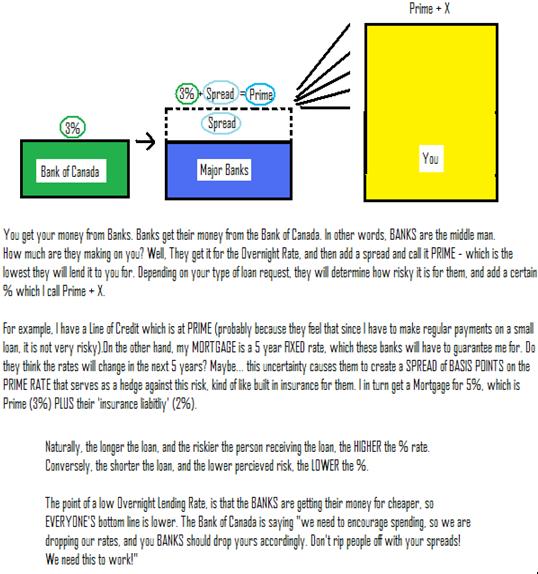
 “Banks borrow from the Bank of Canada at the BoC’s prime rate (also significantly from the bond market, but that’s another story for another day). Banks need to make money, so they charge a “spread”. The spread used to be 150 Basis Points (Bps), then 175 Bps, then most recently 200 Bps.

When the banks didn’t follow the second most recent rate drop of 75 point (in December), the BoC President was not happy and let them know publicly. No mincing of words either. Follow the BoC lead or face consequences.


So they matched the drop by the BoC on Tuesday, but they are still 200 Bps above the BoC rate. So they did exactly what the BoC president said. I think he was hoping for more (i.e. 75 Bps), but I think they’re trying to send him a message. Things are still tight.
The banks prime rate was at 3.5% and dropped to 3%. BoC went from 1.5 to historic low of 1%. The US Fed Reserve is at 0 (yes zero) to 0.25% Also historic.”
 

 John Walsh is not just a smart man, he is also one that I TRUST (Remember the New Social Contract – and what is important to me?). In fact, he is the one I introduced to my fiancé to arrange her mortgage – need I say more?

 John can be reached at:   613-237-7044 x148   or 888-474-0137 (toll free fax)

and at:

jwalsh@mortgagealliance.com
jr2walsh@gmail.com
http://ForAllYourMortgageNeeds.com


Now I put together a picture for you visual learners ( Ok, Ok… it was for me… but it DOES help explain what’s going on here…)


 lending2


Does that help?


New Years Resolutions – Part II

Hi Everyone,


Remember that New Years Resolutions blog that I wrote at the beginning of the new year? Well, I got some good feedback from a few good friends, and I decided to share their comments with you so that you could all see what others are planning in 2009.


Enjoy!


Meet Adam Elsaadi. Adam is a bilingual IT professional with 8+ years experience and a background that blends business, management and technical expertise focusing on management consulting, project management, business transformation, strategic planning, systems analysis, product engineering, development and integration to meet public and private sector client requirements. Clearly, Adam is a busy man. As managing partner at Navigatus Consulting, the bulk of his efforts in 2009 will be dedicated to the provision of IT and Management Professionals to his clients. Adam has set his Real Estate goal of 2009 to acquiring a piece of land in order to build a custom home in 2010.  He can be reached at adam.elsaadi@navigatus.com


Meet Jacquie Chammas. I have known her personally for about 5 years now, and she is VERY driven. Jacquie started University at 16 (yes, SIXTEEN!) with high hopes of becoming a surgeon. She quickly realized that the life of a surgeon was not for her, and she quickly shifted focus to Law, where she will see herself graduating this year with a keen eye on International Law. In the near future, she plans on pursuing her MBA and becoming the CEO of her very own business. I think it is safe to say this is within her potential, wouldn’t you? Jacquie is a proud sponsor parent of 12 year old Thiasara Hansamali Subasigha from Sri Lanka – a true testament to Jacquie’s desire to help those in need. Her Real Estate goals for 2009 include purchasing a condo or a small house to get her started. She clearly recognizes that Real Estate is a sound investment, and is looking forward to getting started! Jacquie can be reached at jacquiechammas@hotmail.com .


Finally, meet Remi Bedirian. He is a 4th year University of Ottawa Finance student by day, and a passionate guitar teacher by night. Remi would like me make clear that he is a handsome young lad, who enjoys long walks on the beach, and is the proud owner of a brand new shiny cell-phone – his first! (You’re welcome Remi!). For 2009 he is focused on completing his degree (with no break in his scholarship, mind you), expanding on his guitar teaching practice, and fine-tuning his Spanish. His Real Estate ambitions for 2009 include educating himself on how to acquire and manage investment Real Estate (something I can help with!). Throught the years I’ve known him, and through all the times we have spent late at night on weekends at University working away, he has mentioned to me that his father is an active and successful landlord, and his brother is a Realtor as well (smart move!). Remi is a great guy with a lot of depth to him, and recognizing this, I asked him to include a little more contact info that the previous two so that he could get a little exposure – here it is:


Email: remibedirian@hotmail.com

My MySpace Page where I post some of my more recent guitar recordings: www.myspace.com/remibedirian

Website: I had an actual website going a few years ago, but never got beyond the one page where I post music. It has some older recordings: http://137.122.145.36/~b4209056/

Down to 1% Overnight!

Hi Everyone,


I will keep it quick.


The market is VERY STRONGLY in favour of those who want to buy right now. My parents just bought a new house, and my fiancé and mother in-law are getting pre-qualified this week to see what they can get their hands on.


More good news:


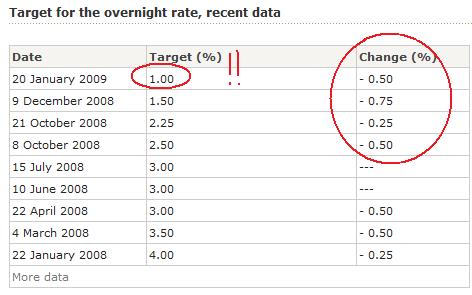
The Bank of Canada just announced their overnight lending rate will go down to 1%!!


Here is a table from the Bank of Canada that I pulled 10 minutes ago:


 11

Source: http://www.bankofcanada.ca/en/monetary/target.html


This means that the BANKS get THEIR money for this amount, isn’t that incredible?


Naturally, this means that the lending institutions can provide you with lower rates on loans as well. I will show you just HOW LOW they are going as soon as I get the info.


You should all realize that THIS IS THE BEST TIME TO BUY REAL ESTATE in over 15 YEARS – maybe longer when I find out how low the lenders will go.


I was speaking to the Mortgage Development Manager from Scotiabank place and she was telling me about a FREE down payment option that they offer!


What this means is that in this incredible Buyers Market, with lending rates as low as they have ever been, there is now an opportunity to acquire some Real Estate with NOTHING DOWN.  I don’t know what else anyone could be waiting for….


I have many friends that are still renting right now and are paying anywhere from $800 to $1200 a month. Their main reason for not buying is that they can’t save for the down. If you can put together a few thousand dollars for closing costs, THAT’S ALL YOU NEED! Gather your savings, borrow from your family, put together some money from your job, get on Kijiji and sell that old stereo – whatever you need to do!


This is not a sales pitch.  If you don’t learn about this opportunity to buy Real Estate before its too late – you will regret it later on.


Don’t forget about the value of a Realtor in this market. If you are a Buyer – a Realtor is FREE – how? The Vendor pays the commissions. I will put together some information about just how valuable a GOOD Realtor can be.


Coming up:


The inside word on the FREE DOWN PAYMENT from the Mortgage Development Manage at Scotiabank, and a mortgage calculator so that you can figure out exactly HOW MUCH IT WOULD COST TO OWN.


What do you want to learn more about? Bankers, brokers, markets, houses, being pre-qualified, Realtors? ASK ME.


P.S. I’ve had a handful of people write me back about their New Years Resolutions. Excellent Work! I will put them all together and post them soon – you will never guess what the people around you are up to!


Cheers and Stay Tuned!

First Piece of Real Estate – Through the eyes of a Real Estate and Mortgage Broker

Many of my fellow students at the Telfer School of Management will be graduating this year, and will be moving on to their next stage in life. Similarly, many people in my age group are upgrading their lifestyles for a variety of reasons – these are indeed the transition years! One of these transitions includes buying their first piece of real estate – likely something small, like a condo for example (which was my first purchase many years ago).  I thought I would ask for some expert insight into what you should all know when considering to buy your first piece of Real Estate, and here is what I have for you:


Mr. John Walsh, a Mortgage Broker with Mortgage Alliance, and also the founder of the Ottawa Real Estate Investors Organization (http://www.oreio.org/ ), has the following to say about first time home buyers:


The biggest fear most of the first time home buyers have from my perspective is that they don’t quite know what’s going on. They are not “experts” in financial matters and when they approach what many perceive as the “big scary bank”, they tend to assume that they are being taken care of (or taken to the cleaners). Whether they are or not depends largely on their personal history with the bank.

The quote I like to give people is that banks are in the business of making money. They are very good at it. To the tune of almost $1B a quarter. Given that this is their focus, do you believe it is in their “best interest” (pardon the pun) to give you the lowest possible rate or do you think it might be a conflict of interest?
As a mortgage broker/agent/professional, I get paid by all the lenders. I also get their best rates and terms automatically as we are “viewed” by the lenders as volume customers. So my interest, is in doing what’s best for my client. My bottom line is also my clients bottom line.

Best advice for anyone buying or not is to pull your own credit bureau. Find out what is on there BEFORE you decide to get a loan. Depending on the score (Becon or FICO as it’s commonly referred to) you receive will determine much of the time the kind of rate you will get. The lower the score the higher the risk and the higher the rate and vice versa.

That $20 Zellers bill that you were never notified of that has been sent to collections could prevent you from getting a mortgage. It just happend to a client of mine.

I also like to compare investing in real estate long term with the stock market. In a given 15 year span, real estate has shown the ability to almost double in value. Worst case senario, the building value drops to near zero. It’s still a place to live and the land will always have some value. Stocks? They can double in shorter time frames, but how low can it go? Well, I guess you could always use it as wallpaper in your house. 🙂

The best time to plant a tree was 15 years ago. The next best time is now. -anchient Chinese proverb.


Mr. Walsh can be reached at jwalsh@mortgagealliance.com or 613-237-7044 x148, or check him out at http://ForAllYourMortgageNeeds.com .


This is great advice. I can personally vouch for the importance of verifying your Credit History. Fill out this form: http://www.equifax.com/ecm/canada/EFXCreditReportRequestForm.pdf

and fax it to Equifax for your Free Credit Report (something I recommend to all my clients).


Next Up: Margaret Burniston, Broker at Partners Advantage GMAC Real Estate. Margaret is a very kind and intelligent woman who is great at what she does. I have recommended her to family and friends before and she has always been a great help.


Margaret tells me that most first time home buying clients are surprised by the amount of additional closing costs that are require. Conveniently enough, she prepared a list of these costs for us today. Here they are:


Commom Home Buying Costs


Purchasing a home can be one of the most exciting and satisfying experiences.  Wise home buyers plan for an additional 1.5 – 1.75% of the price to cover these items involved with the purchase.


Deposit

As a general rule all offers are submitted with a monetary deposit. The amount will vary with the value of the property.  Unlike the other items listed, deposit monies are part of the purchase price and will be deducted from the balance due on closing.


Home Inspection

A knowledgeable home inspector will spend 2 – 4 hours with you examining the home with you. They will check mechanicals, general construction, visible structure, and overall fitness of the property, a good home inspector will also identify ongoing maintenance items.  


Condominium Status Certificate

Condominiums generally have a document called a Status Certificate outlining the condition, financials etc., of the condo corporation.  A careful review of the certificate is recommended by the buyer or the buyer’s lawyer during the conditional period.


Land Transfer Tax

This tax is required by the government to be paid by the buyer at time of closing of the real estate transaction. Land Transfer doesn’t apply on your first home purchase.


Legal fees

The transfer of ownership of the property generally involves the use of a real estate lawyer. It is important to secure a lawyer as soon as possible after the offer has been accepted by the vendor.


Adjustments

This is a category of items that require apportioning (or splitting) on the closing of the transaction. 


Title Insurance

Designed to cover unpredictable or unforeseen issues with the title of the property that become known after closing of the sale.


Home Insurance

All properties are required to carry valid home owners insurance. Covers fire and other hazards.


GST

Goods and Services Tax will be required on all service items including real estate commission and legal fees.


Margaret Burniston can be found at: www.buyandsellottawahomes.com  and contacted at Margaret@buyandsellottawahomes.com or 613-836-3378 x236.

New Years Resolutions

This is the time of year that everyone starts to think about what they want to accomplish in the coming year. For many of us, this is a BIG year, and I mean HUGE. Some of my good friends are working on big promotions, buying another investment property, or my favourite: starting a family!

Take me for example – new job, graduating, getting married, and generally spending a GREAT deal of time doing what I want to do with my life (work in Real Estate, pursue entrepreneurial ambitions, and piece together my future family life).

What about you?

I’m not talking about those regular new years resolutions such as quitting smoking or joining a gym, I am talking about S.M.A.R.T. goals that will bring you closer to where you want to be in life (who wants to call me out on S.M.A.R.T. goals? :)). Examples include: Expanding your network, getting a new job, travelling, starting your own business, graduating, or maybe even buying your first piece of Real Estate.

What else would make a good resolution?

Curious about other’s New Years Resolutions? The next round of blogging will satisfy that curiosity!

Note: I’ve been noticing some great feedback on some of my blogs, and I wanted to let you all know you can click on the TITLE of the specific blog entry to see the comments, and even add your own.

Let’s talk about those resolutions!

Dont take my word for it!

Hi Everyone!


Many people have been running around talking about our current economic and Real Estate market situation. I would like to take this opportunity to provide you with some information that is as ‘cut and dry’ as I can make it.


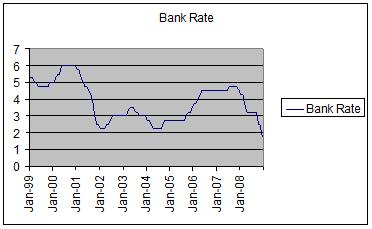
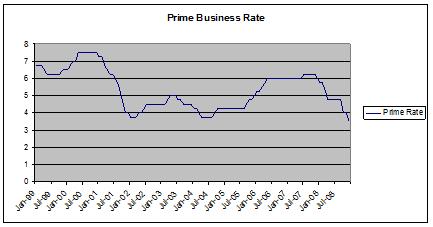
I spent a little while on the Bank of Canada’s website to pull some monthly  rates over the past ten years, and then converting them to graphs (through Excel) to give you an idea of the economic landscape as it appears today.


Observe the Bank Rate (minimum lending rate TO lending institutions from BOC), and the Prime Rate (minimum lending rate BY financial institutions).

(Source: http://www.bankofcanada.ca/en/rates/digest.html converted to Excel)


Bank Rate 1.75%


 bankrate1


Prime Business Rate 3.5%


 primebusinessrate


What we are observing here are historical low lending rates.


Going rates from various mortgage brokers (best alternative to Banks IMO), show 5 year Fixed rates below 5% and Variables just above 4%!!


How about a peek at the value of the stock in the market right now?


In October, the average Canadian home price fell by 10% from a year earlier!

http://www.financialpost.com/news/story.html?id=1008418


That same month, the Financial Post noted that Canadian home sales fell 14%, and then the Globe and Mail noted a further 12.3% in November!

http://www.financialpost.com/news/story.html?id=959714

http://business.theglobeandmail.com/servlet/story/RTGAM.20081215.whomes1215/BNStory/Business/home


Coming to a conclusion:


Lending rates are down to historical lows, and housing prices are following suit.


Do you think that it is a good time to buy?


For more information, don’t hesitate to contact me at mevans@partnersadvantage.ca


Cheers

The New Social Contract

Thirty years ago, employees sought jobs that would offer stability, a competitive salary and good benefits. These life careers would allow the employee to identify with their employers and establish a great sense of trust between the two. Thirty years later, the typical worker has seen over nine jobs. The promise of lifetime employment has been replaced with the opportunity for professional growth, the recognition of accomplishments, and open and honest communication. This change represents an evolution of expectations between employee and employer described as the New Social Contract. This contract is characterized by individualistic motives that place more responsibility on employees for their own success and prosperity in the employment relationship.


The question asks itself, why has this change occurred? Studies have been done that indicate factors like global competition, technological advances and deregulation are the primary drivers. I would like to point to an underlying issue that is often ignored, but is perhaps the most important factor in business and arguably the most important in life: TRUST.  Trust in employers has eroded considerably in the past 30 years. In 2003, a survey conducted by the Centre for Ethical Orientation (CEO) indicated that “nine out of ten Canadians view trust as declining worldwide, and most feel that they are losing trust in private businesses and government institutions.” The director of CEO, Mr. Jim Allen, commented “Generally, in today’s society it takes more to earn people’s trust than it used to. The thing that is most troubling is Canada appears to be moving from a high-trust society to a low-trust society.” He also speculated that much of this lowered sense of trust is do to a feeling of being mistreated and ignored by their employer. This is nothing new, in fact, about three years ago in an Entrepreneurial Culture competition at the Telfer School of Management, Dr. Bruce Firestone spoke to myself and fellow classmates in a workshop about this very issue. The following quote from his website (www.dramatispersonae.org) accurately reflects those words spoken that day, “I believe that the number one thing in life is not love but trust. If you can’t trust the people you love, you have to wonder if they deserve it. Certainly in business and the professions, trust is everything. Did you ever buy anything from someone you didn’t like or trust? Probably not. Do you think you would ever want to hire an architect or an engineer or a doctor that you don’t trust? I don’t think so.”


I have a great example of how this relates to the new social contract, and what it means for employees and employers today. Two weeks ago, I quit my job. I had been working for nearly seven years in the public service. I was making a very competitive salary, I had some of the best benefits in the nation, and my pension was gaining some ground. My management was doing their job, and some of my co-workers were the kindest people I had ever met. So why did I leave? The main reason of course, lies in the new social contract, and what happens when it is not honoured. In my situation, the people were not the problem, the issue however; lied between myself and the institution. The enticements of old no longer appealed to me, and how could they? A lifelong position at the early age of 27, or competitive pay in a world of opportunity seem to lose their appeal very easily. The deal breaker lies in the underpinnings of the new social contract, and to the extent that each side has met their obligations. Were the pay and benefits proportionate to contribution to company success, or was security tied to my ability to perform? Were respect, recognition, and participation complimented with opportunities for growth and development? Perhaps not as much as I would have liked.


Enter potential employer number two. This employer builds a trust based relationship years before the very mention of possible employment. This employer extends themselves to provide opportunity, education and mentoring, all during the course of their work, which ironically enough, coincides with their true passion in life and hardly seems like work at times. This employer places the ball in my court, and places me in an environment in which I can make something for myself, and though hard work, diligence, team work, and TRUST, success will become an inevitable by-product. This employer does have a new set of expectations however, and they are perfectly in line with the new social contract. These expectations include: performance to the best of one’s ability, commitment to the objectives of the firm, participation, a willingness to constantly improve, and a strict adherence to ethical and honest behaviour. Such is the makeup of Partners Advantage GMAC Real Estate, and the opportunity provided for me by Dr. Bruce Firestone.


I have traded in my job security, my cash-for-life government pay and pension, my paid holidays, four weeks vacation time, and all the little perks of being pampered in the public service for a chance to see what I can do in the private sector (not to mention in a time of ‘economic crisis’). Concerns of holiday and compressed day scheduling have been replaced with a concern for whether or not any income will be made in the future, or whether or not I will be sharp enough to make the most out of opportunities all around me. I have chosen a career in an industry that I love, and want nothing more than to perform in it to the best of my abilities. I have surrounded myself with people that are doing what they love to do as well, people that respect each other and the industry in which they operate, and most importantly, good people that I can TRUST. This is where I want to be, and this is what I want to be doing.


What are your thoughts on the New Social Contract? Is it playing a role in your life as well?

Sustainable Community Design

A GREEN initiative that I would like to explore is one that is still catching on around the world and may show the most potential to help improve the quality of the environment, the quality of human health, and the enjoyment of individual and family life. Sustainable community design is a concept that re-organizes life according to a concepts that are often overlooked all too often in society: family, community and environment. An environmentally friendly and sustainable community is one that permits mixed use developments, maximizes the use of the natural surroundings and environmental conditions, and is designed in a way that doesn’t require outside sources of energy to get local processes done.


 One of the best examples that comes to mind is a community design that Douglas Paterson and Kevin Connery created and published in Landscape and Urban Planning, issue 36 (1997). The “master plan for Jericho Hill Village is a product of applying ecological design parameters as determinants of the community’s form and function”. Some of the highlights of this community are VERY interesting, have a look:


  1. Energy Systems
    1. 80% Heat-Energy Savings through exploiting the solar aspects of the site through orientation, thermal masses, high efficiency windows, and location and arrangement of the housing (maximizing day lighting and heat gain to each room). Efficient electrical and mechanical systems, ground source heat recovery systems and roof mounted hot water panels.
    2. 50% savings in transportation energy from creating mixed use development areas. Corner stores and workplaces are located within a 500m walk of all residents. Centralized transit stop to serve as commuting hub.
  2. Water Systems
    1. 60% water savings through open spaces through the communities that channel surface runoff, distribute it, filter it and treat it – thus purifying the water before it is released into the head waters of existing creeks.
    2. Ground water recharge zone under streets, surface runoff into drainage swales, biofiltration beds and green roofs help maintain the hydrologic cycle.
  3. Waste Flows
    1. All of the waste water is processed in solar aquatic greenhouses located at each neighbourhood’s lowest point of elevation, as well as within certain housing developments.
    2. Solar aquatics and adjacent grey water reservoirs are associated with community orchards and gardens where compost and nutrient rich water can be utilized. Solid wasted and composting facilities are also associated with community gardens.
  4. Vegetation
    1. Centralized design permits 60% of the village to remain forested, which would otherwise by consumed by roads, paths and buildings.
    2. The 45% of land within the village that is not consumed by roads and buildings is developed into an urban forest, community agriculture, or recreational open space.
    3. Forests are mixed canopy forests that support complexity and movement for wildlife and provide for viable nesting habitats. These also moderate microclimate changes  by providing shade and wind protection.
    4. Within the village, 60% of the villages food demands are provided for by numerous agricultural operations and numerous allotment gardens.

5. Housing


The housing is designed with two, three and four storey generic massing. Such a design will allow for optimal solar energy use, and will provide sufficient population densities to justify local commerce and hubs for local transit. The height restrictions also allow for optimal use of collected and recycled grey water, for anything higher would require larger footprint.


6. Spatial Form


The village has a civic ‘spine’ that runs from north to south, that will be a pedestrian corridor containing a church/meeting hall, transit hub, commercial core, post office, library, recreation centre and even a school. This spine is never more than 350 meters away from any home, and in most cases is less than 200 meters. Population density will of course be regulated, and pedestrian-only paths and streets will account for most of the streets.


The idea of designing a community that is built for the automobile is, and has been the trend ever since the end of the second world war, when the concept of suburbia was popularized to give the booming population their own piece of the country lifestyle (medium sized frontyards and backyards), while not actually removing themselves from the mass of the community, as the common rural lifestyle does. What has happened, is that this form of community design has become an unbreakable pattern that is upheld and enforced through the city of Ottawa, and as a result many developers are finding it impossible to bring any of these unique ideas to life. Recently, in my City Planning course with the City of Ottawa, we were analyzing a proposed development, and how the city had made objections due, in short, to a design that was impractical for the everyday use of the automobile. We had one gentleman raise his voice when he proclaimed, “Since when do we design communities for the automobile?” He then went on to explain that he was member of a development committee for his particular area in which he lived, and he has become disgusted with how many thoughtful and innovative designs get turned down from the City do to a conflict with archaic regulations that do not reflect the true needs of communities, the environment or even the evolution of everyday lifestyle.


Another great example of such a struggle is exemplified by Dr. Bruce Firestone (Real Estate Broker and Mortgage Broker, Partners Advantage GMAC Real Estate, Bokerage; Founder of the Ottawa Senators, Entrepreneur-in-Residence, Telfer School of Management, University of Ottawa). As he explains, “When we were planning a 600 hundred acre development which we called West Terrace, around what was then called the Palladium (now the Corel Centre where the NHLs Ottawa Senators play), I had many meetings with local planners about our concept design. Along Palladium Drive, we showed nightclubs, cafs, shops and other services fronting on the street. But where are the six meter buffer strip, the double loaded parking aisle, the side yard requirements? they cried. I tried to explain that we wanted to develop a mixed use place somewhere that people could shop, work, live and play a walk about place. But it wasnt in their zoning codes so it couldnt be allowed”.


We are left with a history of regulations that appear to be out of date, and a changing set of needs that demand some sort of reform. What, you may ask, is being done about this? This past weekend I took a trip to City Hall to find some information on just that.  The best information I could find was summarized in the Directory of Environmental Initiatives, entitled “Getting Greener: On the Path of Sustainability. In the development section, their identified targets only speak of a) requiring subwatershed plans or environmental management plans prior to consideration of development, and b) meeting a target of 36% new dwellings within the Greenbelt by 2011. Digging into the specific paragraph about Design Guidelines for Development, much mention is made about ‘supporting’ and ‘promoting environmental sustainability in development’. When it comes to the details about HOW they support these objectives however, (get a load of this): “by specifying design guidelines for Greenfield neighbourhoods, arterial main streets, large-format retail, drive through facilities and collector roads”. UNBELIEVABLE! While they go through the trouble of printing these books on 100% recycled paper, make use of green lettering within the text for effect, and make mention of somewhat progressive environmental initiatives, the very specific guidelines they are employing are directly catered to the use of the automobile! Four out of five of their tools involve automobile accommodation, and the single one that doesn’t make specific mention of the automobile is vague enough to interpret either way.


While I acknowledge the effort, and commend the City on making environmental sustainability an apparent priority, there is still more I would like to see. Perhaps a little more open-mindedness from the City in terms of innovative community design. They could hold competitions that would encourage sustainable design, they could offer grants to pursue more the research and development of environmental initiatives, or perhaps create a specific branch devoted to new environmental concepts and give them some authority. There is a great deal of room for improvement, and it is imperative that we get our ideas out there.


What kinds of ideas can you think of that would support GOING GREEN?

Line 219 – Moving Expenses

Did you know that GOING GREEN is not only friendly on the environment, but can also be friendly on your wallet? By moving closer to where you work, not only would you spend less money and time on transportation, but the move itself could qualify you for a number of tax return deductions, thus keeping more of your hard earned money in YOUR pocket. These deductions apply to those who are employees, self employed and even full time students (in the event that, say, you moved closer to school). Many of the eligible moving expenses include transportation and storage costs for household effects, traveling expenses, meals, and temporary accommodation. You may even qualify for deductions relating to the cost of canceling a lease, legal fees, transfer taxes and even the cost of selling the home! With all the benefits to GOING GREEN (help the environment, save more time for you and your family, save wear and tear on your vehicle, reduce probability of a collision, improve your productivity and enjoy greater flexibility in your schedule, and now tax incentives – to name a few), the move has never made more sense.


Do more for the Earth, your family, your job, your health and now your wallet – GO GREEN!


Determine the moving expenses you can claim by going here: http://www.cra-arc.gc.ca/tx/ndvdls/tpcs/ncm-tx/rtrn/cmpltng/ddctns/lns206-236/219/menu-eng.html .  


What other ways do you think we can improve our lives by going GREEN?


Go Green! Live Closer to Where You Work!
Download the free spreadsheet to calculate the approximate amount of CO(2)
you generate per annum by driving to and from work.

http://www.ottawarealestatenews.com/GoGreenLiveCloserToWhereYouWorkb.xls
To relocate closer to where you work, call our TEAM.
Visit www.ottawarealestatenews.com today!