Are Your Energy Bills Too High?

If you would like to reduce day-to-day energy consumption and lower your
monthly costs, try these practices:
1. Wash only full loads of dishes or clothes.
2. Use cold water for more loads of laundry; hang clothes to dry when you can.
3. Air-dry dishes with the washer door open.
4. Make a sweep through each room before going to bed (or before leaving home for a longer
period of time) and turn off all electrical devices, including television or stereo equipment,
gaming consoles, computers, monitors and printers.
5. Unplug appliances or use power strips to avoid “phantom” energy use, as most electronics draw a
small amount of power even when they are turned off.
6. Use fans for cooling rooms instead of air conditioning.
7. Close window coverings when the weather is warm to keep out heat generated by direct sunlight; open them up when it’s cool outside so the sun’s rays can help warm the space.

Why do mortgage rates rise quickly but fall like molasses?

That’s the question posed by an article in the latest issue of the Bank of Canada Review, and it’s a good one.

The report, by Jason Allen of the central bank’s financial stability department, notes that the big banks that dominate the market tend to adjust interest rates faster when they’re on the way up than they do when rates are falling.

While it come as no surprise to borrowers that such is the case, the article draws an interesting conclusion: That such behaviour by banks and other lenders may have broader implications for Canada’s monetary policy, and that the central bank may want to take this into account when it comes time to plot strategy.
The report comes on the heels of a decision by the federal government to tighten mortgage rules as a way to head off a potential real estate bubble.

All the major lenders in this country tend to offer the same types of mortgage products, credit cards and other services, and in fact Canadians tend to treat their bank as a “one stop shop” where they buy a majority of their financial services, according Mr. Allen.

Leaving aside the issue of whether this is a healthy situation, the author concludes that the mortgage market is “consistent with a model where consumers have different preferences and skills when shopping and bargaining for a mortgage and where lenders maximize profits based on observing these preferences and skills.”

Simply put, borrowers are often complacent and end up paying more than they should.

One of the quirks of the industry in Canada is the prevalence of mortgages with terms of five-years or less, even though the loans amortize over as much as 40 years, according to the article.

Citing a recent study by John Kiff, a senior financial sector expert at the International Monetary Fund, it notes that Americans, by contrast, tend to opt for longer term mortgages than do Canadians, and they have a much broader choice.

The benefit of longer terms is that they provide the borrower with better protection against the risk of rising interest rates. If a loan is amortized over 25 years, the best way for the creditor to ensure he can always make the payments is to take a 25-year term.

Some economists refer to five-year products as “balloon mortgages” because of the possibility that the payments may suddenly shoot up at the end of the term.
Borrowers are also left vulnerable to “roll-over risk,” that the lender may be unwilling to renew the loan at any price.

According to Mr. Kiff, the main reason 10- and 20-year mortgages aren’t more common in Canada is because financial service providers consider them uneconomical.
Whenever banks make home loans they generally protect themselves from the risk that the customer may pay the money back early by including strict repayment penalties. But current regulations put strict limits on such penalties. “So the banks have this wall at five years,” Mr. Kiff said in an interview.

Bottom line: Lenders can’t charge what they feel they need to charge so they don’t offer longer term mortgages at an affordable price.

Mr. Kiff, who previously worked at the Bank of Canada, said Canadians would be better served if there was more choice of longer term mortgages. The IMF recently recommended that the federal government change the rules around mortgages so that lenders are able to provide broader product choice without unnecessary limits on how they charge for products.

What needs to happen is “at least, let the market determine where the rates should be,” he said. “What [mortgage] works best depends on the borrower, on the borrower’s own personal situation.”

jgreenwood@nationalpost.com

Original Source: http://business.financialpost.com/2011/02/17/why-do-mortgage-rates-rise-fast-fall-slowly/

Balanced Market in 2011?

CREA released a revised forecast Tuesday that estimates that 2011 home sales will be down 1.6%, and that prices are estimated to rise by 1.3%. With regards to the forecasts in sales activity, “CREA predicted Tuesday that some sales that would have been made later in the year will likely occur in the first quarter, as a result of the new rules.

Some economists have warned that a combination of higher interest rates and new mortgage rules that go into effect March 18 could put a chill on demand in the later months of this year”. “This is expected to produce a milder version of the volatility in sales activity that we saw last year which resulted from additional transitory factors,” said CREA’s chief economist Gregory Klump.

So we are looking at an active trading season over the spring, but does that mean the summer and fall will be slower than normal? Normally yes, as CREA said earlier – “some sales that would have been made later in the year will occur in the first quarter”, however, CREA also goes on to say that the market will gain traction in the second half of this year as economic conditions, job and income growth and consumer confidence improve, in contrast to 2010 when economic growth softened.

So all in all, it looks like we have some stability in the forecast. The spring will be a little exciting as usual, then it will likely slow at the tail end of the spring, then come back to normal throughout the summer.

RBC gives similar values and a similar story in this report: http://www.cbc.ca/money/story/2011/02/10/rbc-housing-forecast.html

It’s not a sexy market, but the word is FAIR.

Flaherty tables new rules to curb household debt

By David Akin, Parliamentary Bureau Chief

Last Updated: January 17, 2011 8:15am

OTTAWA – The federal government Monday tabled a series of new rules aimed to curbing what it sees as the growing problem of household debt.

Finance Minister Jim Flaherty is changing the maximum length of most mortgages to 30 years from 35 years; cutting the maximum that can be borrowed against a person’s home and eliminating government-backed default insurance of home equity lines of credit.

Prime Minister Stephen Harper said Friday his government was “concerned about growth in the level of household debt.”

Bank of Canada Governor Mark Carney has also been warning of the dangers of rising debt levels.

The key tool the federal government uses to control the mortgage market is the Canada Mortgage and Housing Corp. (CMHC). Banks typically will not provide a mortgage to anyone with a down payment of less than 20% of the purchase price unless the CMHC is willing to backstop the loan.

The CMHC will now no longer insure any mortgage with a term longer than 30 years. Until the change, it was insuring 35-year mortgages.

Flaherty also instructed the CMHC it can no longer insure home equity lines of credits (HELOCs). That means individual banks will be on the hook for any HELOC defaults.

Because banks will assume all of the risks of default, banks are expected to tighten up eligibility requirements for HELOCs.

Finally, a person who wants to take out a loan against their home will be able to borrow a maximum of 85% of the value of their home, down from 90%.

Real Estate Production 2010

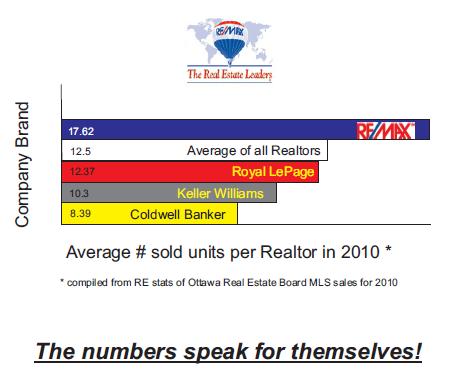
These values were calculated from RE Stats from the MLS information as provided by the OREB for 2010. The brands that were not in the top 4 are not included in this graph, however their sales are used to calculate the average number of units per salesperson (that is the 12.5 number) that is shown in the blank bar in the table .

It proves again the difference between us and the others, and the value that the RE/MAX brand brings to the table.

Real Estate Brokerages and Their Agents in 2010. How did they fare?

I had REMAX Ontario Atlantic review all the stats from the OREB for the whole of 2010.

Results are:

market share: Royal Lepage 31.97% (they have 32.5% of the Realtors)

market share KW 15.2 % (they have 18.2% of the Realtors)

market share REMAX 19.45% (we have 13.86% of the Realtors)

Summary: # units per Realtor in 2010

REMAX 17.62

Royal Lepage 12.37

KW 10.3

*note the average for all companies combined is 12.6 units per Realtor

Or, REMAX agents are 72% more productive than KW Realtors, and 42.44 % more productive than Royal LePage Realtors.

Antennas Up!

A few of you have heard me say this before. It means to be aware of your surroundings, because something is fishy.

Ever get that feeling? It’s called your gut instinct, and I suggest you side with it as often as possible.

When your notice something is strange, you can’t quite put your finger on it, but you know have this eerie feeling about continuing with whatever it was you were doing, here is what I suggest you do:
1) Take a step back. If you are around the people who gave you the ‘jeebies’, just say “Can you give me a second? I just need to make a quick phone call.”
2) Call someone you trust, and that has the time for you. Tell them about the scenario and get a second, objective opinion. Sometimes it’s just you, but more often than not something IS weird, and your trusted friend will confirm it and hopefully be able to give you an idea of what to do about it.
3) Stall or slow down until you’ve figured out how to proceed. If something isn’t right, pump the brakes a little and try to clear the issue before continuing.
4) Tell those that have a vested interest in the outcome, but in utmost confidence. If other people are relying on you and your ability to go through with a deal and put things together, let them know that something seems a bit weird to you, and you will be getting it resolved over the next day or so, and that if they feel the same ‘gut instinct’ to please let you know. You would be surprised how often others have been thinking the same, but didn’t pay enough attention to their gut, or who will now become aware of the same concerns simply because someone told them to pay a little more attention.
5) Deal with the issue. This is quite often the hardest part, but if your ‘partners’ and trusted friend agree that your concern is valid, approach the person or the source of the issue and clarify it. Go to the heart of the issue and clarify whatever concern you have.
6) Control the issue. Some sort of control has to be put in place so that the concern doesn’t come to life later on. Is there some regular checking-in that needs to be done? Should someone else be supervising? Should responsibilities or the scope of the project be changed or reviewed?
7) Antennas Up! Be aware of what might go wrong, and keep your eyes and ears open.

This topic has come to the forefront of my mind recently because as a self-employed individual, my level of responsibility, accountability, and risk have all risen infinetly. My success is subject to so many different variables, that I can’t leave anything to luck or chance, and if something seems to be a little out of place, I had better do my dilligence and clarify that concern or it could be egg on my face.

“Good instincts usually tell you what to do long before your head has figured it out.”
– Micheal Burke

The Athletic Club – Orleans

Have you been to the new Athletic Club in Orleans?

It is the latest rave of the town, and with good reason! The Athletic Club spent over $14,000,000 (that’s no type – fourteen million) on the 65,000s.f. facility located at 3772 Innes Rd, and has so many ways to spend your time and energy, the only thing they are missing is some residential housing so you could stay overnight. From Wi-Fi enabled café’s to anti-gravity yoga, to child care (which can be monitored from the monitors on the cardio machines) and a women’s only fitness club, the local gym’s have better start discounting their fees to compete with the new kid in town. Other innovative programs and services they offer include 160 pieces of cardio equipment, over 140 group exercise classes per week, massage therapy, steam and dry saunas, aquatic centres, whirlpools, weight management programs and nutritional counseling.

Club Hours are from 5am to 8pm Monday to Saturday, and 8am to 8pm on Sundays.
Call 613-824-4100 for more information, or visit http://www.theathleticclubs.ca/

What do YOU think of the Athletic Club?

Market Watch: Keeping You Up To Date

For Release 10:00 a.m. November 2, 2010

Members of the Ottawa Real Estate Board sold 1,042 residential properties in October through the Board’s Multiple Listing Service® system compared with 1,197 in October 2009, a decrease of 12.9 per cent. Year to date, the number of properties sold has declined 2% compared to the same period last year, a record setting year.

Of those sales, 221 were in the condominium property class, while 821 were in the residential property class. The condominium property class includes any property, regardless of style (i.e. detached, semi-detached, apartment, stacked etc.) which is registered as a condominium, as well as properties which are co-operatives, life leases and timeshares. The residential property class includes all other residential properties.

“Six months ago we were in a strong seller’s market, now we have moved into a more balanced market position,” said Immediate Past President Rick Snell. “Some properties are still receiving multiple offers but this is happening much less often than was the case in the spring.”

The average sale price of residential properties, including condominiums, sold in October in the Ottawa area was $340,719, an increase of 6.8 per cent over October 2009. The average sale price for a condominium-class property was $263,292, an increase of 13.4 per cent over October 2009. The average sale price of a residential-class property was $361,560, an increase of 5 per cent over October 2009. The Board cautions that average sale price information can be useful in establishing trends over time but should not be used as an indicator that specific properties have increased or decreased in value. The average sale price is calculated based on the total dollar volume of all properties sold.

Beauty is in the Eye of the Beholder – and quite often, so is Value.

You would think that value would be more clear cut than it is. You would hope that everyone could see value the same way you do, and that there is no real debate about it, because facts are facts, right? Well, the FACTS will tell you that many will people will view and determine value in relation to different criteria based on their individual perspectives, and that something might not be as valuable to one person as it is the next.

Starting to make a little more sense?

Let’s look at a few examples of how someone could determine value:

1) Judgmental Perspective
In Managine for Quality and Performance Excellence (James Evans, Williams Lindsay 2008), the Judgmental Perspective on Value is more of a common notion of superiority or excellence among consumers as a result of marketing efforts, and as such, can not be defined. It is “both absolute and universally recognizable, a mark of uncompromising standards and high achievement.” An example would be the value you perceive when you hear of Ritz-Carlton hotels, or Lexus automobiles.

2) Product Based Perspective
Evans and Lindsay suggest that this view on Value is a function of a specific, measurable variable such as ‘miles per gallon’, or ‘stiches per square inch’. This form of value is not directly related to price, because quite often enough products with similar quality have different prices (perhaps due to Judgmental perspective on Value?)

3) User Based Perspective
This perspective assumes that value is determined by what the end user, or consumer wants. A big supporter of free market principles – I like this definition. This definition would ask “Valuable to whom? and how much would they pay for it?”

Turning to Real Estate, let’s look at the 3 most popular means of determining a Home’s Value.

1) Cost Value
How much would it cost to build the home from the ground up? Did it cost you $100,000 or $500,000? Surely that must be the value of your home, right? “I put in a $5000 furnace, so I increased the value of my home by $5000!”. Maybe….

2) Income Approach
This is a great way to determine value on income producing properties. This approach dictates that the value of the property is determined by the income it could produce at it’s highest and best use. Quite often that is used to sell a property on it’s potential, rather than another form of value (i.e. a tiny bungalow on a regular lot in a suburb VS the one two blocks over on a main road in front of a WAL-MART. You could imagine that there would be more potential with the latter, and it’s list price would likely reflect that). For a type of property that is commonly traded, such as a piece of investment property, be it residential or commercial, the value is nearly always a funtion of how much income it produces (as well as other variables of course, but income is the driving factor).

3)Direct Comparison Approach
This is the one folks. Make no mistake about it, THIS is how you can best guess what your home will sell for. It is based around the principle that an informed purchaser would pay no more for a certain property than the cost of acquiring another existing and equivalent property (http://www.aicanada.ca/section.aspx?id=39). What this means is, “how much is the home worth to a buyer? And at which point would the just as well go and buy my neighbours home?”, because in the end – that is the person that is paying for it. When preparing a home for sale, it doesnt matter how much the City values your home for tax purposes, or a bank appraises your house for, or even what your neighbour or YOU think it is worth – and why? Because none of these people are buying the home.

What you need to focus on is the value of the property in the mind of the person that will BUY your property. How do you determine what a buyer will pay? I’ve found that the best way is to study the past behaviour of buyers in your immediate market, and find out how much they have been paying for a home like yours. Naturally, you will have to make adjustments based on certain features – but don’t be lured in to say “well I paid $5000 for my hot tub, so add $5000 to my house!”….. because you’re just reverting to the cost approach. The proper question to determine adjustment amounts would be “how much is that feature worth to an informed buyer? How much would they pay for that? and at what point is it not worth it to them anymore?”

I understand that this is all easier said than done, because the average Joe or Jane does not ave access to the resources required to find out what homes SOLD for (as opposed to what they were listed for), let alone how much each adjustment should be worth in the real estate market. This does take the proper resources, skill, time and experience to determine.

This is one of the reasons that a Realtor is so Valuable (to the end user) – because they can do that kind of work for you, and often offer it for free as a way to put themselves in front of you.

How do you value your home?

Have you ever heard of someone placing value on their home based on another perspective?